A Telegraph investigation has alleged that the brother of Pakistan Ulema Council Chairperson Tahir Ashrafi is the leader of a group accused of abducting, torturing and blackmailing people through the country’s blasphemy laws.
According to The Telegraph, Ashrafi’s brother Hassan Muawiya Ashrafi has filed blasphemy complaints against 26 people over the past four years, based on police charge-sheets reviewed by the publication.
The report said that police have linked a wider network to corrupt officials and alleged that the group uses social media to lure men into sharing material that can lead to blasphemy charges.
The Telegraph reported that police have described “honey traps” in which women allegedly establish relationships with men online before persuading them to share blasphemous material.
The publication said it spoke to relatives of several alleged victims, who stated that their family members faced abduction, torture and demands for money after being trapped under the laws that carry the death penalty.
One family told The Telegraph that a relative was allegedly abducted after being tricked into sending blasphemous content on WhatsApp. The family was later asked for the value of its house and jewellery, while the man remained in prison after a case was filed against him.
The Telegraph also cited an investigation by Fact Focus, which reported that at least four alleged victims of the gang had died after torture. One victim was allegedly raped with a wooden baton, while another was found with severe bruising around the groin. A prison post-mortem report cited “urine retention” as the cause of death in that case.
In 2024, a Special Branch Punjab Police report also attributed the increase in blasphemy cases to what it called a “blasphemy business gang” involving corrupt officials in the Federal Investigation Agency (FIA). The report named lawyer Rao Abdur Raheem and Sheraz Ahmad Farooqi among alleged ringleaders but did not name Muawiya Ashrafi.
Fact Focus later described Muawiya as the manager of the group’s Lahore operations and published CCTV footage showing him accompanying police during arrests of people accused of blasphemy.
Muawiya has denied being part of a blasphemy gang or taking money from accused. He said that he filed complaints because his mother had told him to “protect the dignity of the Prophet Muhammad”.
The Telegraph reported that Ashrafi has also defended his brother and criticised lawyers representing alleged victims. During a Pakistani talk show in October last year, he said, “If anyone can prove that my brother or I took a single rupee from someone on these cases, you can hang me.”
Ashrafi also called Judge Sardar Ejaz Ishaq Khan “one-sided” after the Islamabad High Court (IHC) judge held 40 hearings into petitions filed by more than 100 families. The proceedings examined allegations of missing evidence, police failures and the repeated use of women in online conversations that allegedly led men to share blasphemous material.
At a political conference in July 2025, Ashrafi referred to Justice Khan while defending Pakistan’s blasphemy laws, saying, “I don’t even consider him a judge. I don’t even consider him a dog.”
The Telegraph reported that the judge later ordered the government to establish a commission of inquiry, but his order was suspended nine days later following an appeal by Rao Abdur Raheem.
While Ashrafi has denied allegations that he and his brother profit from false blasphemy cases and challenged critics to prove that they had taken money from victims, he has also been described in the West as an “interlocutor with hardliner Muslim groups” and as a supporter of Pakistan’s Christian minority.
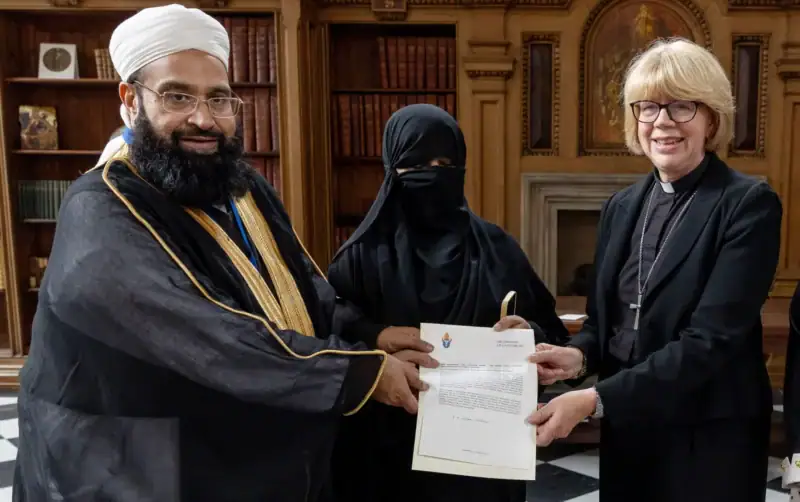
It may be noted that the report by Telegraph also comes days after Archbishop of Canterbury withdrew the Hubert Walter Award announced for Ashrafi for his work on religious tolerance.
Lambeth Palace’s original citation for the award referred to Ashrafi’s intervention in the case of Rimsha Masih, a Christian girl accused of blasphemy in 2012.
However, several minority-rights activists dispute claims that Ashrafi consistently intervenes in blasphemy cases. Human-rights defender Sardar Gill told The Telegraph that Ashrafi defends Christians only when international pressure exists.
Rabia Mehmood, a journalist and former Amnesty International researcher, told the publication that Ashrafi had provided “political cover” to his brother’s campaign.
Lambeth Palace also stated that it recognised the concern over Ashrafi’s inclusion in the awards ceremony and was reviewing how the award was given and its nomination and vetting processes.
Ashrafi was nominated for the award by the Church of Pakistan.