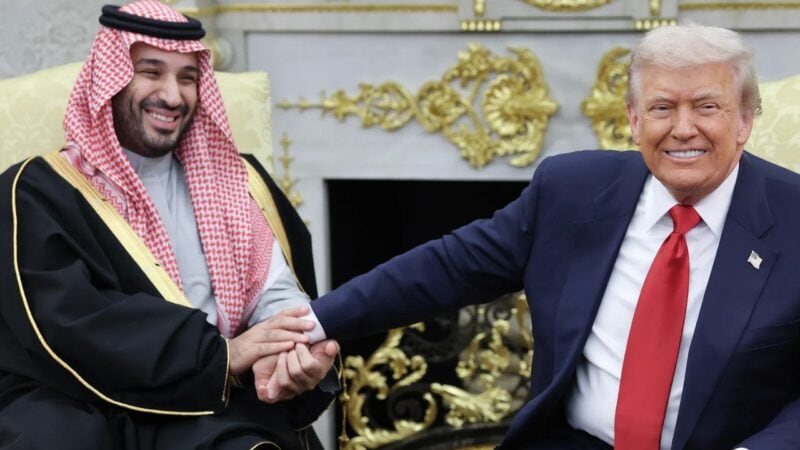
Saudi Crown Prince Mohammed bin Salman (MBS) called President of the United States (US) Donald Trump twice on Thursday, urging him to order strikes against the Houthis as the Iran-backed group advanced towards a key Red Sea chokepoint, an international news report has claimed, citing two US officials.
Trump declined the request, while US officials said that the administration currently has no plans to directly intervene against the Houthis.
The calls came as Houthi forces expanded their control along Yemen’s Red Sea coast, taking the last coastal towns held by forces of the internationally recognised Yemeni government early Friday.
Two Yemeni government sources told an international media outlet that Houthi forces had reached Dhubab, a coastal town directly opposite Perim Island at the Bab el-Mandeb Strait. Yemeni government sources had said on Thursday that controlling Dhubab and Perim would be key to controlling the strait.
The Houthis have also reportedly reached Perim Island, which sits at the mouth of the Red Sea and divides the Bab el-Mandeb Strait. Yemeni government officials said their forces had withdrawn from the island, although the Houthis had not immediately confirmed that they had reached Perim.
A military official from Yemen’s internationally recognised government told a news agency that the Houthis had also seized Greater and Lesser Hanish, the last two islands in the Bab el-Mandeb Strait that were not under their control.
The Bab el-Mandeb connects the Red Sea with the Gulf of Aden and carries oil, fuel and other international trade between Asia and Europe. The Houthi advance has raised concerns over movement through the waterway.
The latest request marks a shift from July, when MBS asked Trump for political backing to strike Sanaa airport but told him Saudi Arabia did not require US military assistance. Trump backed the move at the time.
The Houthis later retaliated by attacking Saudi tankers in the Red Sea, putting the route used for the kingdom’s oil exports under threat. The group later expanded its attacks to Saudi energy facilities, prompting Saudi Arabia and its Yemeni allies to launch airstrikes and ground offensives against Houthi positions.
As the conflict intensified, Saudi Arabia began seeking more US support despite earlier telling Washington that it could handle the Houthis itself.
US military and civilian officials have also told their Saudi counterparts in recent weeks that Trump wants American forces to remain focused on Iran and the Strait of Hormuz instead of opening another military front, according to sources familiar with the discussions.
MBS first called Trump on Thursday as Houthi forces advanced on the coastal city of Mokha and Saudi-backed Yemeni forces withdrew, US officials said.
Several hours later, he called Trump again and urged him to order US strikes against the Houthis.
Trump rejected the request. However, a US official said that Washington would provide Saudi Arabia with intelligence on the Houthis and targeting data.
Around 200 US military personnel are already stationed in Saudi Arabia to provide non-kinetic support, the official added.
A senior Trump administration official said that Washington’s focus remains on keeping the Red Sea open while allowing regional partners to handle the wider conflict.
“The United States is focused on protecting our core national security interests — such as ensuring freedom of navigation in the Red Sea — while empowering our regional partners to take the lead in managing and resolving regional security challenges,” the official said.
“We are in continuous dialogue with Saudi Arabia and the Republic of Yemen Government regarding regional stability.”





