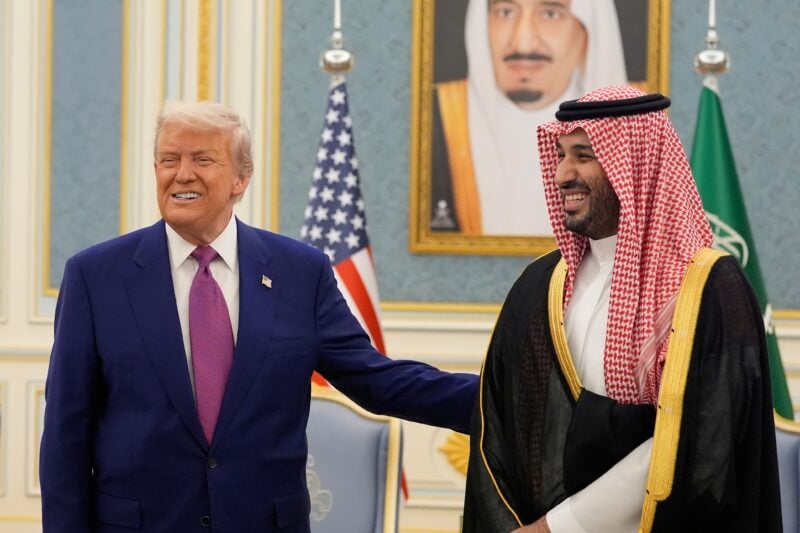
President of the United States (US) Donald Trump has sent a proposed agreement with Saudi Arabia on civil nuclear energy to Congress on Monday. An administration official confirmed that the pact will only enter force if Riyadh normalizes relations with Israel.
The agreement, completed in July, allows American companies to export civilian nuclear technology to Saudi Arabia.
Under the rules governing the deal, Congress has 90 session days to evaluate the proposal. The 30-year agreement outlines plans for constructing AP1000 nuclear reactors, a project worth tens of billions of dollars that stands to benefit Westinghouse, a firm jointly owned by Canada-based Cameco and Brookfield Asset Management.
According to the reports, leadership received the deal on Monday, with referrals to relevant committees expected on Wednesday. The agreement takes effect automatically unless Congress passes a resolution to block it within 90 session days.
If lawmakers vote against the pact, US President Trump holds the authority to veto their resolution, which would then require a two-thirds majority in both houses of Congress to override.
The administration maintains a strict condition on the arrangement.
Diplomats previously noted that Saudi Arabia approached recognition of Israel in 2023. However, the genocide in Gaza that began in October 2023 halted the discussions. Saudi officials maintain that recognition requires an irreversible pathway to a Palestinian state.
The text of the nuclear deal has drawn scrutiny from Democratic lawmakers and nonproliferation experts because it lacks explicit bans on uranium enrichment or spent fuel reprocessing, two paths capable of producing nuclear weapons material.
The United Arab Emirates (UAE) accepted the restrictions in its 2009 nuclear deal with Washington.
The administration asserts that the agreement complies with standard nonproliferation laws. However, policy experts note that submitting the text starts a clock that could allow the deal to take effect regardless of diplomatic progress.
Henry Sokolski, head of the Nonproliferation Policy Education Center, pointed out that the move creates a scenario where the deal might advance without meeting those conditions. “This is hardly ideal if you’re serious about no enrichment and recognition of Israel,” Sokolski said.