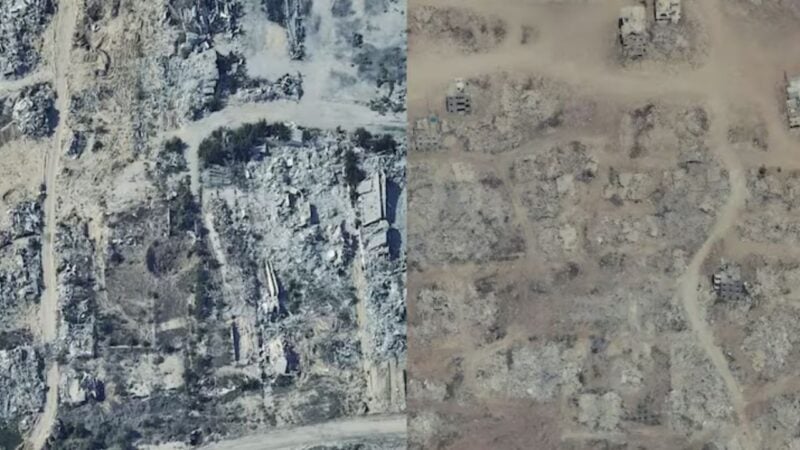
Updated Google Maps satellite imagery is now showing the scale of destruction across Gaza, with entire neighbourhoods appearing flattened and large areas covered in rubble as the genocide at the hands of Israeli occupying forces continues in the territory.
The imagery shows roads running through areas where densely built neighbourhoods once stood, while buildings in some locations are no longer distinguishable from the surrounding rubble.
Khan Younis and Rafah are among the areas where streets and neighbourhoods appear heavily damaged. Google Maps markers for schools, mosques, parks and restaurants can still be seen in some locations, but the markers only show places that were previously recorded on the platform and do not confirm whether the structures remain standing.
Palestinian journalist Abubaker Abed was among those who highlighted the updated imagery on X.
“Large parts of the Gaza Strip have been updated on Google Maps. I’ve walked through much of the destruction in Gaza myself, but I couldn’t bear looking at the map,” he wrote.
“I’ve been to those places, I have seen the scale of the destruction – it was really heartbreaking. But when you see all the destruction in just one active website, it really broke my heart,” Abed told an international media outlet.
He said that the imagery was particularly difficult to view because it showed places where he was born and grew up now reduced to ruins.
The updated imagery also shows extensive damage around Al-Shifa Hospital, once Gaza’s largest medical complex. Israeli forces withdrew from the hospital on April 1, 2024, after a two-week siege.
A World Health Organization (WHO) mission that reached Al-Shifa on April 5 reported extensive destruction and described the hospital as an “empty shell”. The mission found major damage to its emergency, surgical and maternity buildings.
“What I was most struck by is that every place that I used to visit before the genocide was a mountain of rubble, and heaps of rubble are everywhere,” Abed said.
The destruction shown in the imagery comes as international assessments continue to document the impact of the Gaza genocide.
A final Gaza Rapid Damage and Needs Assessment released by the United Nations (UN), European Union and World Bank in April estimated that more than 371,888 housing units had been destroyed or damaged. It also found that more than 50 percent of hospitals were non-functional, nearly all schools had been destroyed or damaged and Gaza’s economy had contracted by 84 percent.
The assessment estimated Gaza’s recovery and reconstruction needs at $71.4 billion over the next decade. It also found that around 1.9 million people had been displaced, often multiple times, while more than 60 percent of Gaza’s population had lost their homes.