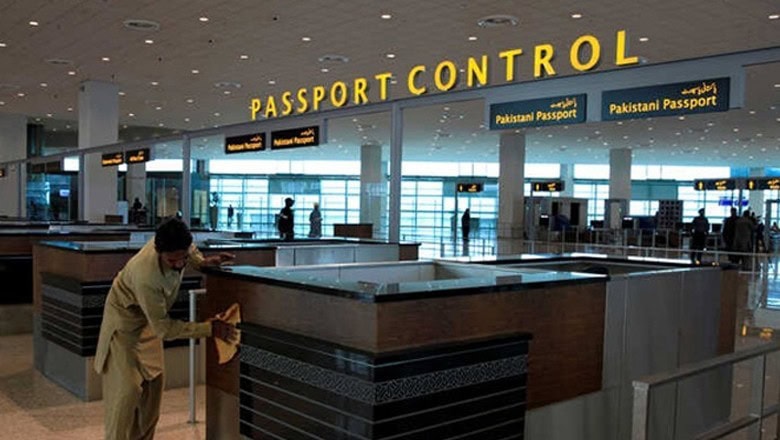
The administration of President Donald Trump has backed a $2.4 billion investment proposal by a US firm to install security systems at major airports in Pakistan aimed at identifying criminals and cross-border threats.
US Chargé d’Affaires to Pakistan Natalie A Baker supported a proposal by Securiport to deploy Advanced Passenger Information (API) and Passenger Name Record (PNR) systems, according to official documents. She urged Pakistani authorities to review the offer.
The proposed system would enable data transfer from airlines to the government while ensuring that Pakistan retains full ownership and control of the data, with round-the-clock support and training included.
If accepted, the proposal could speed up the installation of such systems. A separate plan by the Pakistan Airports Authority (PAA) to deploy similar systems has drawn scrutiny after the Senate Standing Committee on Defence raised concerns over transparency.
Securiport has offered to cover all upfront costs for deploying the system and recover expenses over time through a government-approved passenger security surcharge model.
Under the proposal, the company plans to invest $2.4 billion over a 25-year contract period. It has also proposed setting up a local subsidiary to train over 1,000 Pakistanis in related technologies.
In a communication with the Ministry of Defence, which oversees the PAA, Baker extended US government support for the proposal and endorsed the deployment of API and PNR systems by Securiport.
“We appreciate your consideration of Securiport’s proposal and continued partnership with the US in advancing Pakistan’s security and our efforts to achieve safe, secure and efficient travel”, said Natalie, in a correspondence with Pakistani authorities.
According to the proposal, the Federal Investigation Agency (FIA) would operate the API and PNR systems, providing an integrated biometric-based border management mechanism.
Natalie noted in her letter that Securiport has over two decades of experience across multiple countries and follows a compliance framework.
When approached, a spokesperson for the US embassy in Islamabad stated that the embassy does not comment on private diplomatic correspondence and referred queries to the Pakistani government.
Defence Minister Khawaja Asif has not clarified as yet whether Pakistan would accept the proposal.
Securiport provides border security, biometric systems and threat assessment services to governments. The company’s system can “detect and interdict criminal and transnational threats in real-time at the border,” Natalie stated in her letter, adding that it ensures secure data transfer with full government ownership and support services.
The proposal aligns with Pakistan’s plan to introduce an automated border control system, known as e-gates. However, the initiative has faced questions after the contract was awarded to a state-owned entity under Public Procurement Regulatory Authority (PPRA) direct contracting rules.
The International Monetary Fund (IMF) has asked Pakistan to withdraw provisions allowing direct contracting with state-owned enterprises under its governance and corruption assessment conditions.
The PAA had earlier issued a global request for proposals in 2020 for e-gates, API and PNR systems, followed by a fresh expression of interest in 2024. Both processes were not taken forward.
In January, the Senate Standing Committee on Defence was briefed on the project. Officials informed the committee that e-gates equipped with biometric passport scanners and facial recognition were planned to reduce immigration processing time from three to five minutes to under 45 seconds per passenger.
The system would be linked with the FIA’s exit control list, PNR systems and Interpol databases to flag high-risk travellers in real time.
The committee raised concerns that the bidding process may not have followed PPRA rules and directed the Ministry of Defence to provide complete procurement records for review.





