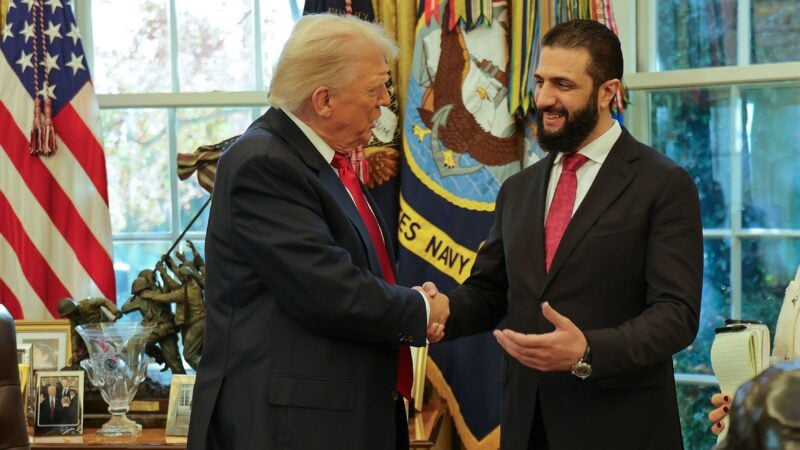
The United States (US) has officially removed Syria from its state sponsors of terrorism list on Monday, eliminating what Damascus identifies as the final primary barrier to attracting foreign capital as Washington expands diplomatic ties with the country’s new leadership.
The update appeared on the US Treasury’s website following the completion of a mandatory 45-day congressional review period. US President Donald Trump initiated the formal timeline on July 8 when he officially notified Congress of his intention to rescind the designation.
US Secretary of State Marco Rubio highlighted the policy rationale in an official statement.
“These actions were all taken in recognition of the positive actions taken and further commitments by the Syrian government under President Ahmed al-Sharaa to fully distance Syria from acts of international terrorism,” Rubio said.
Syrian Foreign Minister (FM) Asaad al-Shibani emphasized the financial implications of the decision, noting that Damascus expects the action to restore Syria’s connections to the global banking structure.
Washington originally placed Syria on the state sponsors of terrorism list in 1979 under the government of former President Hafez al-Assad over allegations of supporting militant organizations. The designation remained active through the governance of his son, Bashar al-Assad, until a rebel movement led by current President Ahmed al-Sharaa knocked down the government in December 2024.
Monday’s decision also revoked the designation of the Nusrah Front as a Specially Designated Global Terrorist organization. Following Syria’s removal, Cuba, Iran, and North Korea stand as the remaining nations on Washington’s state sponsors of terrorism list.
The terrorism classification enforces broad restrictions on US foreign aid, military exports, dual-use equipment, and international money transfers. The status served as a persistent deterrent for foreign commercial banks and international investors, even after the Trump administration repealed comprehensive economic sanctions against Syria in July 2025.
The US Treasury confirmed that American banking institutions may now offer direct financial services to Syria, process transactions with Syrian banks, and set up correspondent banking arrangements, provided no targeted entities participate. Specific targeted sanctions stay in effect against Bashar al-Assad, associated officials, human rights violators, narcotics networks, Islamic State members, al Qaeda factions, and Iranian-backed groups.
Corporate entities signaled interest leading up to the regulatory change. Syria’s finance ministry reported that Finance Minister Mohammad Yisr Barnieh conducted direct discussions with Bank of America executives regarding potential operational integration into the global financial network. Ministry officials stated that bank representatives expressed interest in visiting Syria to advance dialogue.
Payment processor Mastercard announced in May that it partnered with QNB Group and the Central Bank of Syria to construct local infrastructure for global card processing, positioning itself as an early economic participant in the market.
Trump previously informed Congress of his intent following a direct summit with Sharaa in Ankara in July, delivering a letter assuring the Syrian president of efforts to remove barriers blocking economic recovery.
The regulatory adjustment concluded months of detailed negotiations between officials in Damascus and Washington. As part of those discussions, Syrian authorities agreed to scale down Russian crude oil imports significantly.