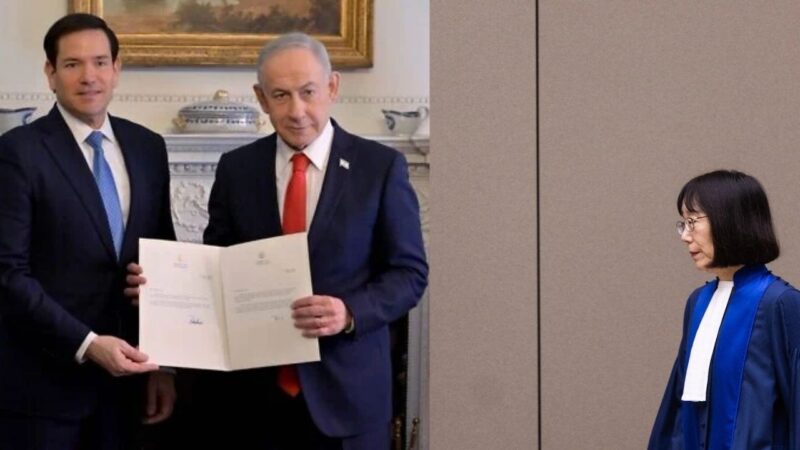
The United States (US) has imposed sanctions on International Criminal Court (ICC) President Tomoko Akane and senior trial lawyer Abdoulaye Seye, as the Trump administration continues its campaign against the court.
US Secretary of State Marco Rubio announced the imposition of the sanctions, accusing the ICC of pursuing cases against officials from countries that have not accepted the court’s jurisdiction.
Rubio said that Akane and Seye were being sanctioned for their involvement in efforts to “prosecute officials whose government has not consented to ICC jurisdiction”.
He also described the ICC as “a corrupt and fatally politicized supranational court that has maliciously abused its authority and exceeded its mandate. We will not tolerate its assault on state sovereignty.”
The ICC responded by defending its officials and stating that the measures threatened the international legal system.
“Measures targeting judges, prosecutors and staff who work towards the fulfilment of the mandate that was conferred to the ICC by States undermine the rule of law,” the court said.
“When judicial actors are threatened for applying the law, it is the international legal order itself that is placed at risk.”
The latest move adds to a series of sanctions already imposed by the Trump administration on at least 11 ICC officials, including judges and the court’s chief prosecutor.
The sanctions include travel restrictions, asset freezes and limits on services provided by US companies.
Washington DC has said that the measures were introduced in response to ICC investigations involving US personnel in Afghanistan and arrest warrants issued against Israeli officials, including Prime Minister (PM) Benjamin Netanyahu, over allegations of war crimes in Gaza.
Netanyahu has rejected the allegations and accused the court of acting out of antisemitism. Neither the United States nor Israel is a member of the ICC.
However, Palestine joined the court in 2015, allowing it to examine alleged crimes committed in Palestinian territories.
Trump has repeatedly criticised the ICC since his first term, when he told the UN General Assembly that the court had “no jurisdiction, no legitimacy, and no authority” over the United States.
Last month, Rubio urged the ICC’s member states to withdraw from the court as part of what he described as a campaign to dismantle it “brick by brick”.
Human rights organisations have criticised the administration’s actions, arguing that they undermine international law.
“The Trump administration seeks a get-out-of-jail-free card for whomever it chooses,” said Liz Evenson, international justice director at Human Rights Watch.
Her comments came after four US human rights organisations filed a lawsuit in New York, arguing that the sanctions prevented them from working with the court on cases involving genocide, war crimes and crimes against humanity.
In June, three ICC judges also challenged the sanctions in a federal court in New York, arguing that the measures were intended to pressure and punish members of the judiciary.
The ICC was established in 2002 and has the authority to prosecute genocide, crimes against humanity and war crimes in member states or in cases referred by the UN Security Council.
In a video statement released in July, Rubio accused the court of “waging a war against our country” through “statutes, compacts and the force of so-called international law”.
“Today, it threatens every aspect of our political and legal system,” he added. “If they believe they can deprive us of our sovereignty, we will teach them the full meaning of American resolve.”