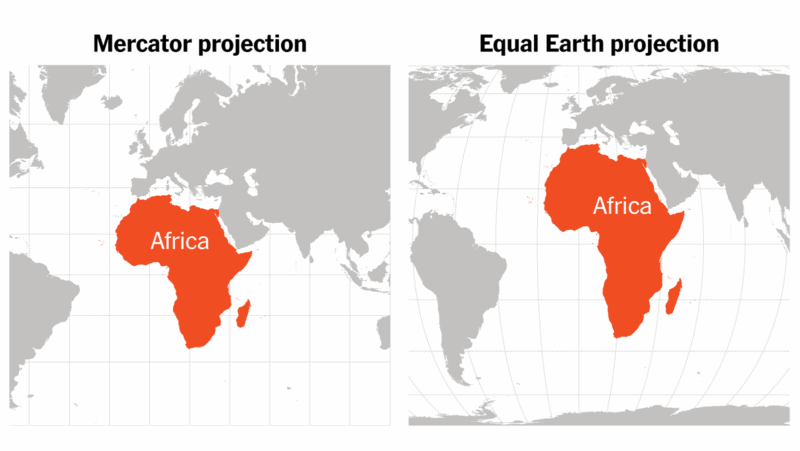
The United Nations General Assembly (UNGA) has voted to replace the Mercator world map with a map that more accurately represents the size of Africa.
The “Correct the Map” resolution, sponsored by Togo and backed by African Union (AU) members, received support from 164 countries, including France and the United Kingdom (UK). The United States (US) was the only country to vote against the resolution, while six countries abstained.
The resolution is non-binding, but its adoption will lead to changes in the maps used by institutions around the world.
The Mercator projection, which has been widely used since the 16th century, has faced criticism because of the way it represents the size of continents. On the map, Africa appears similar in size to Greenland, although Africa is actually 14 times larger.
Critics argue that the distortion can minimise the development needs and potential of countries located near the equator.
Flemish cartographer Gerardus Mercator designed the map in 1569 to help European explorers navigate across the world.
Its distortion comes from the difficulty of representing the surface of a globe on a two-dimensional map. Any world map requires compromises when converting the Earth’s curved surface into a flat representation.
The Mercator projection makes countries near the equator appear smaller than their actual size, while countries closer to the poles appear larger.
Cartographers created the Equal Earth projection in 2018 as an alternative that represents the relative areas of continents more accurately. In February, all 54 AU member states adopted the projection and said it “more accurately represents the sizes of all continents, particularly Africa”.
The online campaign group #CorrectTheMap, which supports replacing the Mercator projection, said that Africa is large enough to contain the United States (US), China, India, Japan, Mexico and much of Europe while still having land left over.
Ahead of the UN vote, Togolese Foreign Minister (FM) Robert Dussey told an international media outlet, “A fair world begins with a fair map.”
At a UN briefing, Dussey also said that a map is never neutral, arguing that maps influence how people understand the place of countries and continents in the world.
French FM Jean-Noël Barrot supported the move and said that France’s foreign ministry would stop using the Mercator map. He said that changing the map would not change the world, but correcting a representation that distorts it would be “an act of truth”.
The US opposed the resolution. US representative at the UN Yaryna Ferencevych stated that the UNGA should focus on issues including international peace, prosperity and relations instead of what she described as map projects dating back to the 16th century.
Lerato Mogoatlhe of Africa No Filter, one of the groups behind the campaign, said that Africa’s representation on world maps was “not just a cartographic error” but also a narrative issue.





