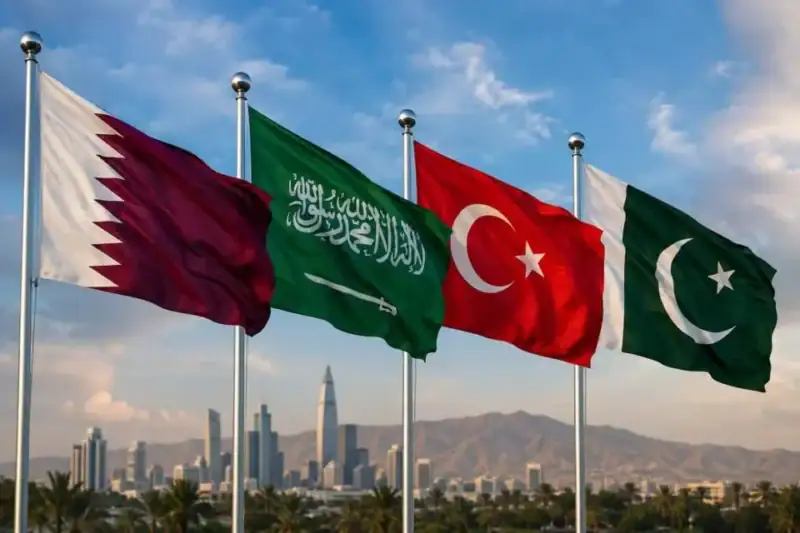
Qatar has welcomed the Makkah Joint Defence Agreement signed between Saudi Arabia, Türkiye, and Pakistan, stating that the pact contributes to security, stability, and defense across the region.
Speaking at a weekly news conference in Doha on Tuesday, Qatari Foreign Ministry spokesman Majed Al-Ansari stated that Doha views defense frameworks based on cooperation and good neighbourly relations positively.
“We welcome any regional cooperation that strengthens security, stability and defense among the countries of the region,” Al-Ansari said.
Al-Ansari noted that Qatar maintains strategic relations and fraternal ties with all three participating nations, grounded in a shared destiny and common concerns. He added that Qatar supports the steps taken by the three countries.
“For the security of our region and the security of the world, we fully positively view any defense framework based on cooperation and good-neighborly relations,” Al-Ansari said.
The spokesman emphasized that regional security remains a collective responsibility requiring direct coordination and cooperation among neighboring nations.
Turkish President Recep Tayyip Erdogan, Saudi Crown Prince Mohammed bin Salman, and Prime Minister (PM) Shehbaz Sharif signed the pact on Friday in the city of Makkah.
The agreement forms part of broader defense cooperation that does not target any specific nation. Instead, the framework seeks to strengthen commitments toward preserving regional and global peace, stability, and prosperity through burden-sharing and a joint understanding of security.
Under the terms of the pact, the three member nations aim to strengthen collective deterrence against potential acts of aggression. The pact stipulates that an armed attack directed at any one of the three member states constitutes an attack on all three.
The framework also outlines specific defense arrangements requiring the three countries to support the security of each member state, expand cooperation within the defense industry, and enhance military interoperability among their respective armed forces.