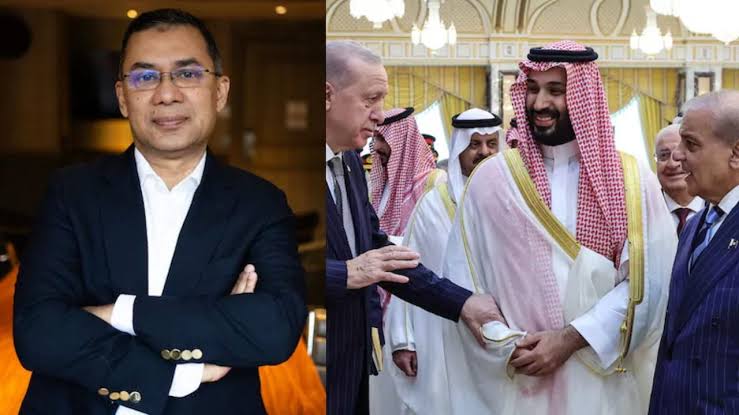
Bangladesh has indicated willingness to join the Makkah Joint Defence Agreement involving Pakistan, Saudi Arabia, and Turkiye, a news agency has reported.
Speaking to state-run news agency Bangladesh Sangbad Sangstha (BSS), Foreign Affairs Advisor to the prime minister of Bangladesh Humaiun Kobir stated that Bangladesh maintains a positive approach towards joining an economic or defence framework involving the three nations.
Kobir pointed out that the government evaluates such decisions while considering national interests and changing global economic and trade dynamics.
He stated that the government pursues a balanced foreign policy under the “Bangladesh First” principle, placing national interests at the center of diplomatic engagements.
Kobir added that Bangladesh strengthens the working bilateral relationship with Pakistan as part of normal diplomatic interaction, focusing on trade and bilateral people-to-people connectivity.
Saudi Crown Prince Mohammed bin Salman, Turkish President Recep Tayyip Erdogan, and Prime Minister (PM) Shehbaz Sharif signed the Makkah Joint Defence Agreement on August 7 during the Makkah Al-Mukarramah Summit for Joint Defence.
The pact establishes that an armed attack against any one signatory state constitutes an attack against all three. The agreement provides for enhanced defence cooperation among the signatory states, aiming to strengthen collective security and promote peace, security, and stability.
The signing follows heightened tensions in the Middle East due to the United States (US)-Israel war on Iran, which began on February 28. The war has drawn in several Gulf states and disrupted maritime traffic through the strategic Strait of Hormuz.
Deputy Prime Minister (DPM) and Foreign Minister (PM) Ishaq Dar stated on August 9 that the Makkah agreement remains open to countries willing to uphold the core principles of the pact.
Dar said that the accord serves defensive purposes and does not abrogate or replace existing bilateral or multilateral agreements involving the signatories. Dar also emphasized that the framework remains open to nations committed to cooperation, mutual respect, and the peaceful resolution of differences.
Turkish FM Hakan Fidan stated a day after the signing that the pact functions technically like NATO’s Article 5 mutual defence arrangement.
Fidan clarified that the accord does not target Iran or any other country. Fidan noted that the agreement serves as a general pledge to support the security of the allies, adding that President Erdogan favors expanding the framework, with Egypt identified as a potential candidate.