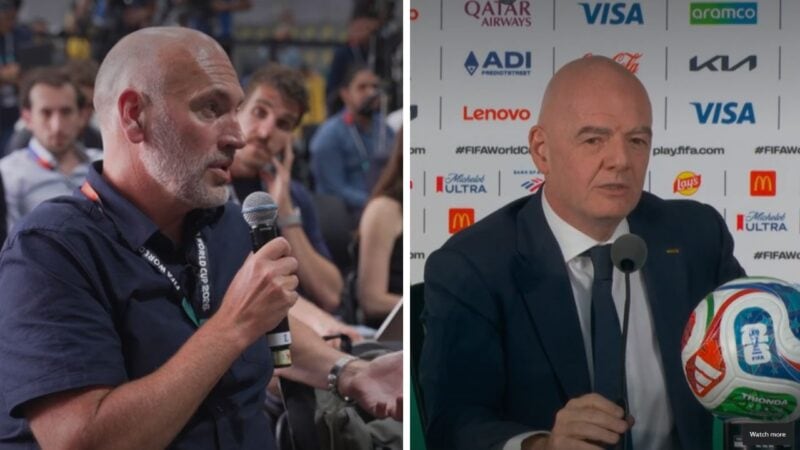
FIFA president Gianni Infantino faced harsh questions at a press conference on Wednesday as BBC sports editor Dan Roan pressed him on a series of travel restrictions and visa rejections clouding the build-up to the 2026 FIFA World Cup.
Roan raised the case of a Somali referee who was denied entry into the United States (US) and sent back home, accused of having links with suspected terror organisations. He also referenced Iran being forced to relocate their training base to Mexico and fans and journalists from multiple countries unable to attend the tournament due to travel bans and visa restrictions.
“You yourself have said in the past how important it is to have freedom of movement at a global event like this,” Roan told Infantino. “Are you embarrassed, therefore, by what has actually come to pass? And do you have to accept that you’ve lost some control of your own tournament,” he questioned.
Infantino pushed back, questioning whether FIFA should be expected to dictate immigration policy to host governments.
“Would you find it normal that FIFA would dictate to the British government who to let in the country and who not to let in the country?” he asked, referencing the possibility of the UK hosting the 2035 Women’s World Cup.
The FIFA president acknowledged the scale of the logistical challenge, noting that around 300,000 accredited people, the majority from outside the United States, required vetting.
“Security goes above everything and you need to respect the decisions which are taken,” he stated.
Infantino asked those present to trust FIFA’s work behind the scenes. “There are things we can know, things we cannot know, things we are told, things we are not told,” he said. “We always try to make the situation as positive as possible and to find solutions. Sometimes we manage. Other times, not,” he added.
He also pointed to Iran’s participation as a sign of progress. “I think it has already been successful to bring Iran to play in America. I don’t know who would have managed to do that.”
It is worth noting that the tournament build-up was clouded by a string of travel and visa problems.
Somali referee Omar Artan, named the CAF Best Male Referee of 2025 and set to become the first-ever Somali World Cup official, was denied entry at Miami airport. Iran had at least fifteen officials and team staff denied visas ahead of the tournament.
Iraq striker Aymen Hussein, who scored the goal that sent Iraq to the World Cup for the first time since 1986, was detained and questioned for nearly seven hours at Chicago’s O’Hare airport before being allowed into the country.
Woodensky Pierre, the only member of Haiti’s squad who lived in the Caribbean country, was granted a late visa after weeks of uncertainty.
Switzerland forward Breel Embolo could not travel with his team after his travel authorisation was flagged due to a previous legal conviction, though he was cleared and joined his teammates two days later.