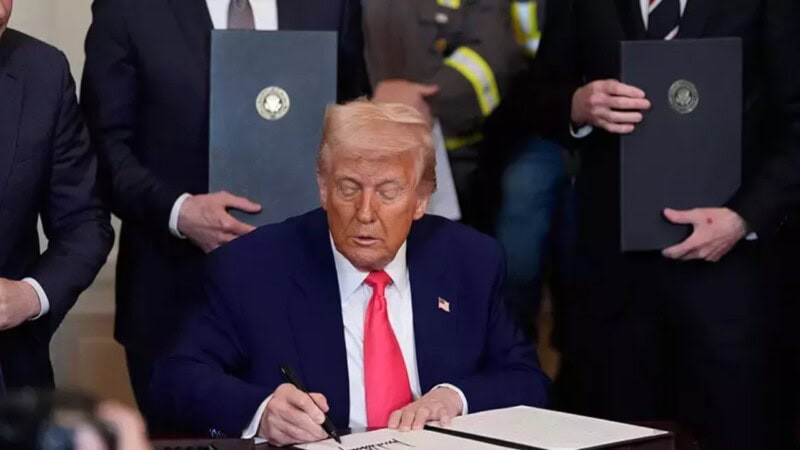
In a major shake-up of global trade dynamics, U.S. President Donald Trump has officially raised the China tariff to a staggering 104%, marking a new peak in the ongoing trade war.
This tariff hike is part of Trump’s broader plan to enforce reciprocal trade practices, where countries that impose tariffs on U.S. goods are met with equal or greater tariffs in return.
What Led to the 104% Tariff?
The decision followed a back-and-forth escalation between Washington and Beijing. Trump first imposed a 34% tariff. China retaliated. Trump then added another 50%, bringing the total to 104%.
China’s leadership wasted no time issuing a stern response. The Ministry of Commerce accused the U.S. of making “a mistake upon a mistake” and warned of significant counteractions.
In response, China’s Ministry of Commerce expressed strong opposition, calling the move a “mistake upon a mistake” and vowing to retaliate further. Potential Chinese countermeasures include:
-
Higher tariffs on U.S. agricultural products (soybeans, sorghum)
-
A ban on U.S. poultry
-
Suspension of fentanyl cooperation
-
Limits on American media and film imports
-
Restrictions on legal and financial services
-
Investigations into U.S. intellectual property earnings
China’s state-backed media emphasized the country is not seeking a fight, but it “won’t shy away from one” either.
Potential Chinese Countermeasures to the U.S. Tariff
China’s potential retaliation includes:
-
Increased duties on U.S. agricultural products
-
New bans on American poultry and meat
-
Suspension of fentanyl cooperation with the U.S.
-
Possible delays in Hollywood film imports
-
Crackdowns on U.S. media and tech companies operating in China
How Will the New Tariffs Affect American Shoppers?
With 104% tariffs in place, prices on everyday consumer goods are expected to skyrocket. Shoppers may feel the sting on:
-
Mobile phones and laptops
-
Toys, games, and children’s products
-
Fashion and footwear
-
Home appliances and tools
Tariff Impact on E-Commerce: Shein, Temu, and AliExpress in the Crosshairs
The executive order targeting e-commerce imports under $800 means massive price jumps for products ordered from Shein, Temu, and similar platforms.
These low-cost retailers were previously shielded by the de minimis threshold. Now, they’ll face 90% import taxes, likely pushing U.S. consumers to buy less.
Market Fallout: Global Financial Shockwaves
Stock markets around the globe tumbled in reaction to the announcement:
-
Wall Street dropped sharply
-
Asian stock markets posted losses across the board
-
Investors moved funds into “safe haven” assets like the Japanese yen and U.S. Treasury bonds
What Industries Are Most at Risk?
Industries that heavily rely on Chinese imports or exports are particularly exposed:
-
Automobile parts and electronics
-
Retail and apparel brands sourcing from China
-
Agriculture, especially soybean and corn producers
-
Technology and semiconductor firms
A Look at the U.S.–China Trade Relationship by the Numbers
Here’s a breakdown of trade volume and tariff levels:
-
U.S. imports from China: $439 billion (2024)
-
U.S. exports to China: $144 billion
-
Tariff rate under Trump (2020): 19.3%
-
Average tariff today: Nearly 125%
Trump’s Stance on Global Trade: No Room for Compromise
Trump remains firm that only “tailor-made” deals will be considered. Blanket trade arrangements are off the table, and no delays to tariffs are expected.
Despite global pushback, Trump is standing firm. According to Press Secretary Leavitt, he has no intention to pause or delay the tariffs. However, he is open to “tailor-made” trade deals with countries willing to negotiate — just not on generic terms.
“He expects that these tariffs are going into effect,” said Leavitt. “He’s not interested in off-the-rack deals.”
Economic Experts Warn of Long-Term Damage
Economists are sounding the alarm. They warn of:
-
Rising inflation
-
Slower GDP growth
-
Risk of job losses in key export sectors
-
The possibility of a global economic slowdown
International Reactions: Allies and Rivals Concerned
The European Union, Canada, and Japan have all voiced concern over the escalation. The EU, in particular, may face similar tariff hikes if it fails to negotiate a new trade deal with the U.S.
European Union leaders have expressed concern, with EC President Ursula von der Leyen warning against a “spiraling” trade war. The EU faces tariffs between 11% and 50% if it doesn’t negotiate soon.
Former Commerce Secretary Carlos Gutierrez declared that the U.S. and China are now in a “full-blown trade war.”
Billionaire backers like Ken Langone and Ken Griffin are furious, fearing long-term damage to the American economy.
Will Supply Chains Shift Away from China?
Some companies are already exploring options to move manufacturing to:
-
Vietnam
-
Mexico
-
India
However, shifting production isn’t instant. Businesses could face months — if not years — of transition costs and supply disruptions.
Conclusion
With tensions rising and both countries digging in their heels, the 104% China tariff may mark the beginning of a new era of economic nationalism. Global markets, consumers, and policymakers will all be watching closely to see who blinks first.
Read More: Tony Blanco Dies Saving Friend in Devastating Nightclub Collapse