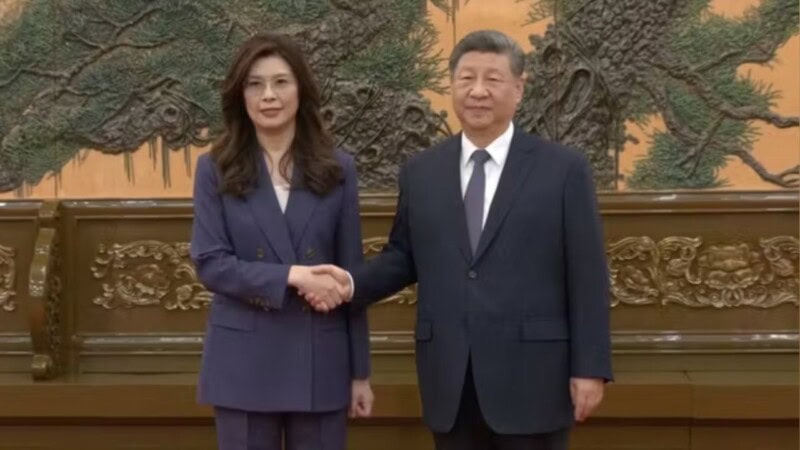
Chinese President Xi Jinping met Taiwan’s main opposition leader Cheng Li-wun on Friday, in a rare high-level engagement where both sides stressed the need for stability across Taiwan.
Cheng, who leads the Kuomintang (KMT), is the first sitting party chief to visit China in a decade.
Beijing had suspended formal communication with Taiwan in 2016 after Tsai Ing-wen from the same Democratic Progressive Party (DPP) took office and declined to endorse the “one China” principle. The DPP has criticised Cheng’s visit, accusing her of aligning too closely with Beijing.
China considers Taiwan part of its territory and has not ruled out the use of force to assert control.
Speaking at the meeting held at the Great Hall of the People, Xi said, “The leaders of our two parties are meeting today in order to safeguard the peace and stability of our shared homeland, to promote the peaceful development of a cross-strait relations, and to allow future generations to share in a bright and beautiful future.”
He added that China is open to dialogue with different political groups in Taiwan, including the KMT, provided that they oppose independence for the island.
Xi also reiterated that people on both sides of the Taiwan Strait are Chinese and share an interest in maintaining peace.
Cheng, in her response, said, “The rejuvenation of the Chinese people is a shared aspiration of the people on both sides of the Strait.” She added that such engagement would be a “positive contribution to world peace and human progress.”
At a press conference after the meeting, Cheng stated that younger generations need to recognise that opposing Taiwan independence and supporting the 1992 Consensus helps “avoid war, prevent tragedy, work together and create peace.”
The 1992 Consensus refers to an understanding between the KMT and China’s Communist Party that there is “one China,” while allowing each side its own interpretation. The DPP has rejected the framework, arguing that it undermines Taiwan’s sovereignty.
KMT has historically maintained ties with Beijing, though analysts note that Cheng’s visit marks a shift from the more cautious approach adopted by earlier party leaders.
China has also declined to engage with Taiwan’s current president Lai Ching-te, describing him as a “separatist.”
Lai has said that he intends to maintain the existing state of relations, while Chinese officials and state media have criticised him, calling him a “troublemaker” and “warmonger.”