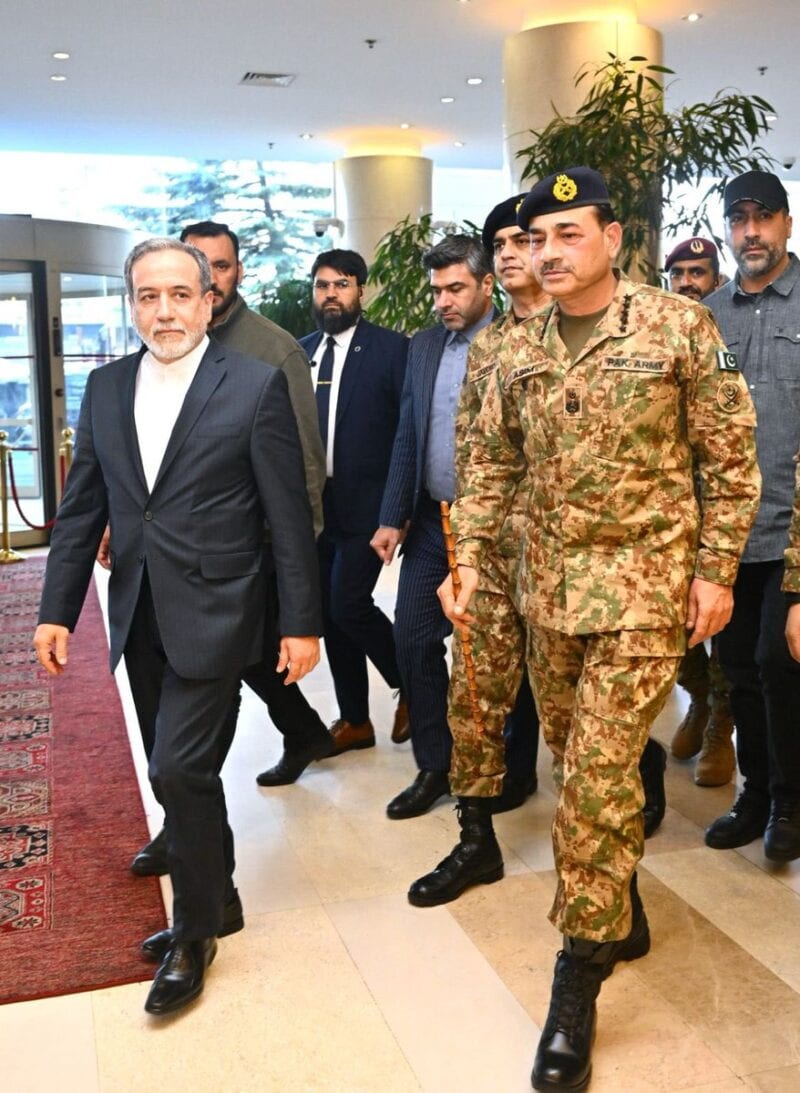
Pakistan’s Chief of Defence Forces (CDF) Field Marshal Asim Munir and Iranian Foreign Minister (FM) Abbas Araghchi have discussed efforts to revive diplomacy over Tehran’s conflict with the United States (US), a Pakistani security official told Reuters.
According to reports, the telephonic call between the two focused on the US-Israeli war with Iran, the possibility of returning to talks and Houthi attacks on Saudi Arabia.
The discussion comes as shipping activity through the Strait of Hormuz fell further. Seven vessels transited the waterway on Thursday, compared with 11 a day earlier and a 10-day average of 15.
US Central Command (Centcom) stated that it had also redirected 96 commercial vessels as part of its naval blockade of Iran.
Four unknown projectiles also struck two vessels four nautical miles west of Oman’s Khasab, according to the United Kingdom (UK) Maritime Trade Operations. The incident caused a fire on one vessel, while the status of the second vessel remained unknown.
The master of another vessel reported seeing the projectiles hit the two ships about six nautical miles north of his position.
Iran’s Islamic Revolutionary Guard Corps (IRGC) Navy meanwhile attacked an unmanned US naval vessel at the entrance of the Strait of Hormuz, Iranian news agency ISNA reported. The IRGC identified the vessel as a Seadragon with hull number 5838.
The diplomatic and military developments came as Iran rejected renewed accusations over its nuclear programme at the United Nations (UN).
Iran’s ambassador and charge d’affaires to the UN, Gholamhossein Darzi, described the allegations as political rather than technical in a letter to the president of the UN Security Council. Iran also argued that Resolution 2231 expired in October 2025.
“The renewed accusations against Iran’s peaceful nuclear program are political in nature, not technical,” Darzi wrote.
Iranian Deputy Parliament Speaker Ali Nikzad stated that Tehran would continue fighting foreign aggressors “until complete victory”.
Speaking at a ceremony in Taleghan, he added that Iran remained opposed to the US and Israel, adding that the two countries had “failed to understand the Islamic Republic of Iran and its people”.





