The United States (US) has expanded its sanctions targeting Iran’s oil and cryptocurrency sectors, taking aim at the shipping network of petroleum magnate Mohammad Hossein Shamkhani, according to the US Treasury Department.
This economic escalation marks the official end of the ceasefire between Washington DC and Tehran. The brief truce, which was signed last month, has collapsed following a series of military exchanges over trade routes in the Gulf region.
Reacting to the initial developments, Chinese Ambassador Sun Lei stated that major US attacks against Iran have once again pushed the region into a dangerous precipice.
Shortly after, an Iranian drone strike targeted a US military base in Kuwait.
In western Iran, US projectiles hit a wheat storage silo overnight in Hoveizeh County, located in the Khuzestan province. The province’s deputy governor confirmed the strike but reported no casualties.
Jordan’s military announced that its air defense systems intercepted and shot down three Iranian ballistic missiles. The army confirmed the missiles entered Jordanian airspace from Iranian territory, adding that the interception caused no casualties or material damage.
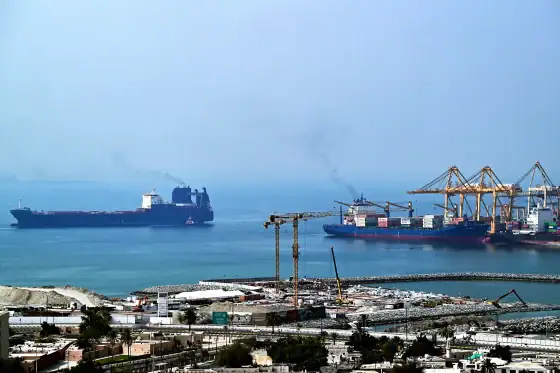
Ahead of the impending US blockade, shipping data on Kpler showed an increase in vessels transiting through the Strait of Hormuz, with the majority linked to Iranian trade.
Out of eleven vessels passing through, nine used the Iranian route. This included three empty oil tankers, an Aframax-sized vessel, and two Very Large Crude Carriers entering the strait, while exports exiting included a VLCC loaded with two million barrels of crude, a medium-range tanker carrying refined products, and two tankers carrying liquefied petroleum gas.
Iran’s Islamic Revolutionary Guard Corps (IRGC) announced that they had targeted command-and-control, logistics, fuel, and military equipment facilities belonging to the US Fifth Fleet in Bahrain.
The Guards warned that if Washington attempts to block regional oil and gas exports by controlling maritime routes, other corridors serving US and allied interests would be closed, stating regional energy exports would be “for everyone or for no one.”
Oil prices rose following the flare-up as President Donald Trump’s reimposed naval blockade on Iranian ports prompted retaliatory strikes from Tehran on US infrastructure in the region. Brent crude rose by 1.72 percent to 86.19 dollars a barrel, while West Texas Intermediate climbed 1.4 percent to 80.40 dollars.
Iranian state television reported separate army and Revolutionary Guard attacks on US targets in Jordan and Kuwait.
The military stated it targeted the Al-Azraq base in Jordan with drones, while the Guards fired cruise missiles at a US military logistics center at Mina Abdullah in Kuwait, warning that the Strait of Hormuz will remain closed until US aggression ends.
US Central Command confirmed it completed an additional round of strikes, hitting dozens of military targets near the Strait of Hormuz and coastal areas of Iran. The seven-hour wave involved fighter aircraft, drones, and naval vessels deploying precision munitions against Iranian missile, drone, naval, and coastal defense systems.
To tighten the economic squeeze, US Treasury targeted Mohammad Hossein Shamkhani’s shipping network with additional sanctions. Treasury Secretary Scott Bessent stated the department is working on “shutting down the financial infrastructure that allows the regime to continue its threats to US national security and global shipping.”
Meanwhile, the Aq Qala railway bridge has returned to full operational status 24 hours after being hit by a US strike.
The International Maritime Organisation reported that the death toll from strikes on commercial vessels in Omani waters has risen to two. In response to the loss of an Indian crew member, New Delhi summoned an Iranian diplomat.
Iranian state media agency IRNA reported that US forces launched projectiles targeting Qeshm Island, with assessments underway to determine the extent of the damage.
Speaking to reporters, US President Donald Trump claimed the Middle East is “coming together” to get rid of the “bully of the Middle East”. He defended the military escalation, stating: “I gave them a chance. I wanted to give them a chance at making a deal. They shot first, and that was a big mistake, because we have been knocking the hell out of them”.





