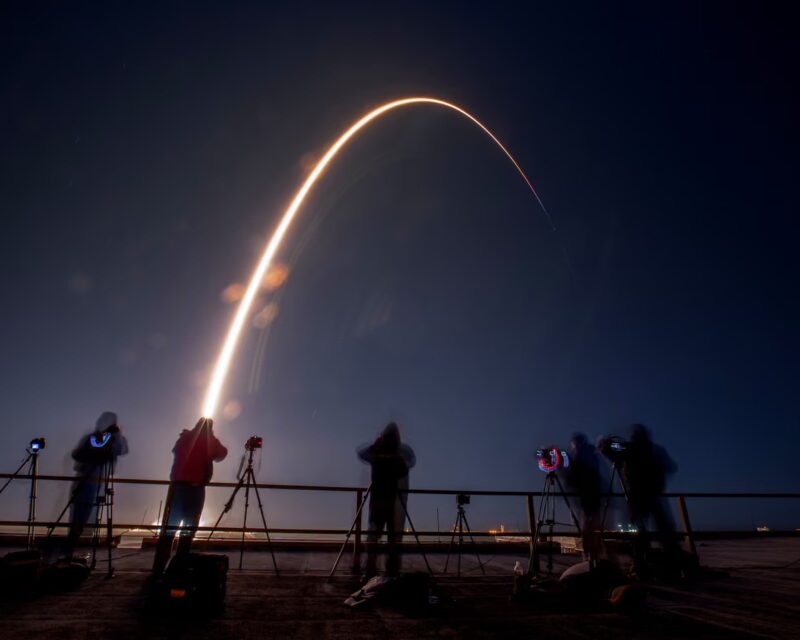
A four-tonne discarded piece of a SpaceX Falcon 9 rocket collided with the moon on Wednesday morning, travelling at a speed of 5,400 miles per hour.
The building-sized rocket stage spent over a year floating uncontrolled in space before hitting the lunar surface. While the collision poses no threat to Earth, scientists expected the impact to create a crater measuring roughly 60 feet wide and 12 feet deep on the moon’s surface.
The rocket piece originally launched a lunar lander for the American firm Firefly Aerospace in January 2025.
Standard rocket stages usually drop back into the atmosphere of Earth to burn up or land in the ocean. However, the high-thrust requirements of the Firefly mission pushed the second stage into a higher orbit.
The rocket body remained in space as uncontrolled debris after dumping its remaining fuel.
Astronomers tracked the trajectory of the hardware earlier this year, calculating that gravitational forces and solar activity directed the stage onto a collision path with the moon.
“What has happened is essentially a mixture of solar activity and gravity forces have put it on a path toward the moon,” Julianna Scheiman, the SpaceX director of NASA science and Dragon programmes said.
The high-speed impact kicked up a multi-mile plume of lunar dust. Neither professional nor amateur astronomers could confirm the collision immediately with telescopes, as the crash occurred near the visible edge of the moon.
NASA plans to track the site using orbiter cameras to capture images before and after the collision. “The impact poses no danger to Earth and Nasa scientists are planning to collect lunar data from the event and refine techniques for tracking objects in space,” NASA spokesperson Jimi Russell said.
Independent astronomer Bill Gray, who published a tracking report on the stage in April, noted the broader implications for orbital debris management. “This may be of some, probably minor scientific interest, and we may learn some things from it. It doesn’t present any danger to anyone, though it does highlight a certain carelessness about how leftover space hardware is disposed of,” Gray stated.
Accidental hardware impacts on the moon remain uncommon, though a Chinese rocket stage hit the surface in March 2022 following a test mission.
NASA also intentionally crashed a stage into the moon in 2009 to examine debris plumes.
Multiple unmanned missions have also suffered crashes during landing attempts, including the Russian Luna-25 in 2023, the Indian Chandrayaan-2 in 2019 and the Israeli Beresheet lander in 2019.