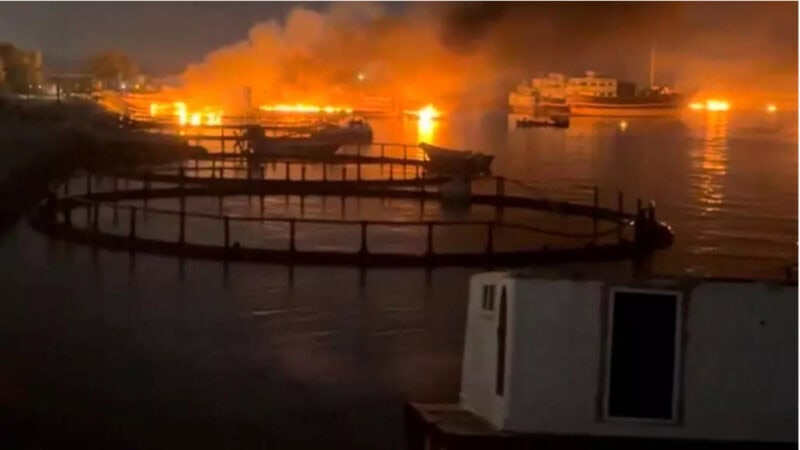
The United States (US) military launched a fresh round of airstrikes against Iran, targeting assets in the country’s west and southwest. Official Iranian news agency IRNA reported that three people were killed and several others wounded on the outskirts of Ahvaz, quoting Valiollah Hayati, the deputy governor of Khuzestan for security and law enforcement.
Following a second consecutive day of American strikes, maritime traffic through the Strait of Hormuz ground to a near-halt. Bloomberg News cited ship tracking data showing that only a US-sanctioned supertanker and an Iranian-flagged container ship were seen exiting the Gulf.
Fourteen cargo vessels crossed the strait, marking the lowest traffic volume since the US-Iran Memorandum of Understanding (MoU) signed on June 16.
US Central Command (Centcom) stated that approximately 90 military targets were hit, including air defence systems, missile storage sites, and drone facilities.
In a statement on X, Centcom noted that the military completed an additional round of strikes on July 8 “to further degrade Iran’s ability to attack commercial shipping and innocent civilian mariners in the Strait of Hormuz.”
Iran’s Revolutionary Guards (IRGC) retaliated by targeting US military bases in Bahrain and Kuwait.
Iranian State television IRIB carried an IRGC statement confirming strikes on “key infrastructure and facilities” at the Arifjan and Ali Al Salem bases in Kuwait, as well as the Juffair and Sheikh Isa bases in Bahrain, utilizing missiles and drones.
The IRGC warned that actions would expand to other regional bases if American attacks continued.
Following the escalation, the Bahraini interior ministry announced on X, “The siren has been sounded. Citizens and residents are urged to remain calm and head to the nearest safe place.”
Simultaneously, the Kuwaiti military confirmed on X that its air defences were intercepting “hostile missile and drone attacks,” noting that “any explosions heard are a result of air defense systems intercepting hostile attacks.”
Oil prices reacted volatily to the military activity, with Brent crude futures rising 78 cents, or 1 percent, to reach $78.8 a barrel. US West Texas Intermediate crude futures (WTI) climbed 74 cents, or 1.01 per cent, settling at $74.26 a barrel.
Iran’s chief negotiator, Mohammad Bagher Ghalibaf, stated on X that the Strait of Hormuz would open only under “Iranian arrangements.” Ghalibaf wrote, “The United States still has not learned that bullying and breaking its promises no longer come without consequences. Let me be clear: If you strike, you will be struck.”
US President Donald Trump issued a warning in a post on Truth Social, accompanying a photograph of a targeted site in Iran. Trump wrote, “This is in retribution for yesterday’s bombing of ships by Iran. If it happens again, it will get much worse!”
Iranian media reported further explosions across the country. The Mehr news agency reported explosions in the southwestern Bushehr province, while Press TV stated that eight explosions occurred in Bandar Abbas as air defences activated. Fars news agency reported explosions in Chabahar and Konarak, with IRNA noting that power cuts occurred in Chabahar.
Centcom confirmed the fresh operations took place hours after Trump declared that the interim agreement to end the war with Iran was “over.”
Centcom stated on X, “The United States is holding Iran accountable for recent unjustified aggression against commercial shipping and civilian crews freely navigating a vital international waterway.” Centcom added that 20 US naval vessels are patrolling Middle Eastern waters.
UN Secretary-General Antonio Guterres expressed concern over the developments. His spokesperson, Stephane Dujarric, stated, “The secretary-general is alarmed by the renewed military confrontations in the Gulf. The incidents that we have seen over the last 24 hours risk derailing the diplomatic progress achieved between the Islamic Republic of Iran and the United States.”
Iranian officials responded directly to American warnings. Ebrahim Rezaei, the spokesman for the Iranian parliament’s Foreign Policy and National Security Committee, wrote on X that “not even a single American soldier will return alive,” following threats concerning Kharg Island.
Iranian Foreign Ministry spokesperson Esmaeil Baqaei stated on X that the US violated the Islamabad MoU framework through “unilateral actions” and “aggressive attacks.” Baqaei wrote, “The memorandum of understanding between Iran and the United States, from its very first step, was not established on the basis of trust, but rather on the clear mechanism of ‘commitment for commitment’; because there was no sign of good faith in the opposing side’s behaviour.”
Foreign Minister Abbas Araghchi added on X, “Iranians are known for their civility, culture, and strong moral values. We do not answer vulgarity with vulgarity, but with action: fearlessly and with great valour.”
Trump downplayed the probability of a sustained escalation while speaking to reporters, “I don’t think it’s going to start again. I think it’s going to go very quickly. They hit a couple of ships, and so we hit them much harder. Anything that happens is going to be over very quickly … and will only make it safer, including for oil.” Trump added, “I’m number one on the kill list for Iran.”
The Pakistan Foreign Office issued a statement urging both sides to de-escalate. The statement noted, “A renewed conflict is in no one’s interest. Pakistan calls on all parties to exercise restraint and refrain from any actions that may further undermine regional peace and stability. There is no alternative to continued engagement, dialogue and diplomacy to achieve a shared goal of peace in the region.”