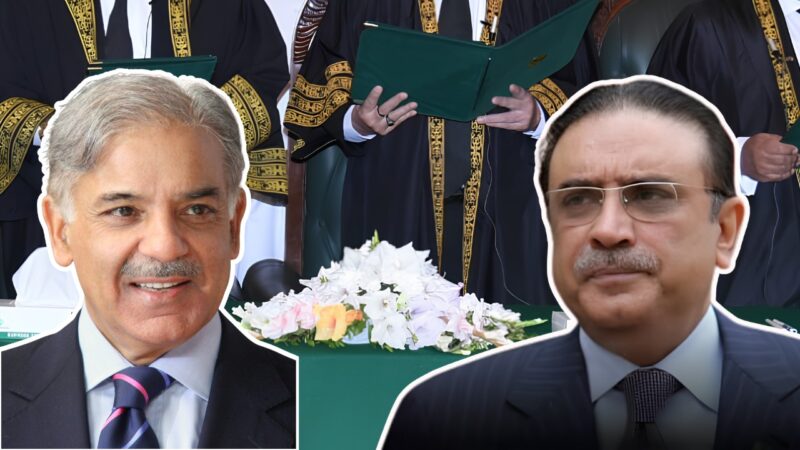
The federal government is considering notifying the appointment and confirmation of high court judges without President Asif Ali Zardari formally approving the summary forwarded by Prime Minister (PM) Shehbaz Sharif, as a constitutional dispute over the president’s role in the process deepens.
Reports quoted government sources as saying that officials were examining whether Article 48(1) of the Constitution could allow the appointments to proceed after the 15-day period for presidential action has elapsed.
The provision requires the president to act on the advice of the premier or cabinet, while allowing him to ask for reconsideration within 15 days.
The Judicial Commission of Pakistan (JCP) had, at meetings on July 20 and 21, recommended 19 additional high court judges.
It also confirmed four additional judges of the Peshawar High Court (PHC) and one of the Lahore High Court (LHC), while extending the tenure of an additional Sindh High Court (SHC) judge by six months.
The recommendations have not yet been notified by the Ministry of Law and Justice because the president has not formally approved the summary.
The delay has already affected judges whose existing terms expired. The four PHC judges ceased to hold office on Aug 4, while the tenure of the SHC judge expired on July 29.
Minister of State for Law and Justice Barrister Aqeel Malik said the government would resolve the matter “within the constitutional framework” and according to procedures laid down by the Constitution and superior courts.
Presidency sources, however, were quoted as cautioning against bypassing the established procedure, saying such a move could create political and legal complications.
They said Articles 48(1), 48(2) and 175A(8), which govern the president’s role and the appointment of judges, could be interpreted differently.
Meanwhile, the Islamabad High Court (IHC) reserved its verdict on the maintainability of a petition challenging the delay.
Justice Arbab Muhammad Tahir questioned whether a constitutional petition could be brought against the president and asked the petitioner’s lawyer to identify any precedent for courts directing the president in exercising powers under Article 48.
The lawyer argued that the president’s role in judicial appointments was ceremonial and that the law ministry could issue notifications even without presidential assent. The court declined to issue notices at this stage and reserved its decision.