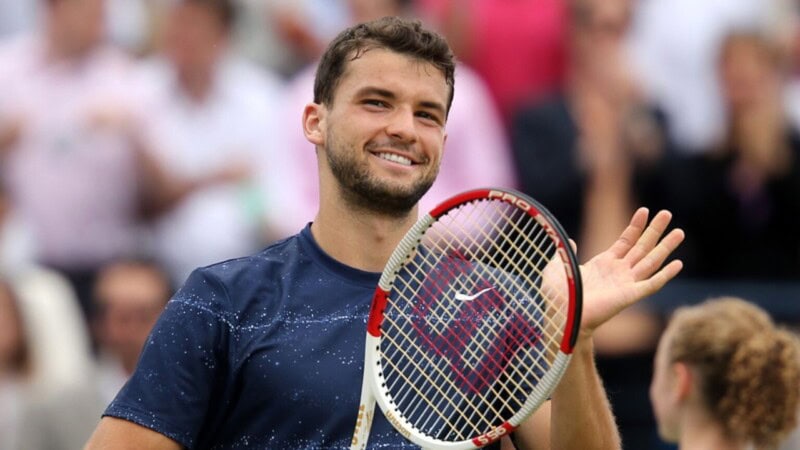
Grigor Dimitrov is one of the most technically gifted tennis players of his generation. Born on May 16, 1991, in the small Bulgarian city of Haskovo, he rose from modest beginnings to become a world-class athlete. Standing at 1.91 meters tall, he commands the court with elegance, balance, and precision. Over the years, he has achieved remarkable success, including reaching world No. 3 in the ATP rankings and winning the 2017 ATP Finals. Yet for much of his career, one label has followed him wherever he plays: “Baby Federer.”
This nickname has been both a blessing and a challenge, shaping how fans, media, and even opponents have perceived him. To understand why it stuck and why it matters, we need to explore its origins, the ways it has influenced his career, and how Dimitrov has ultimately forged his own identity in the world of tennis.
The Early Rise of a Bulgarian Prodigy
Dimitrov’s journey began under the guidance of his father, Dimitar, a tennis coach, and his mother, Maria, a sports teacher. From the moment he could hold a racket, his natural ability was clear. He won junior titles across Europe, developing a game that combined fluid movement with precise shot-making. By 2008, he was ranked the No. 1 junior in the world, winning both the Wimbledon and US Open junior titles.
When Dimitrov turned professional, the tennis world was eager to see what he could achieve. The timing was perfect: Roger Federer was dominating the sport, and fans were looking for the “next big thing.” The young Bulgarian’s graceful one-handed backhand, effortless footwork, and attacking instincts drew immediate comparisons to the Swiss champion. It was during this period that the nickname “Baby Federer” began to circulate among commentators and fans.
Why “Baby Federer” Caught On
The similarities between Dimitrov and Federer were hard to miss. Both possessed a rare one-handed backhand, a weapon known for its beauty and difficulty. Both preferred an all-court game, moving seamlessly between the baseline and the net. Dimitrov’s serve motion, forehand technique, and court positioning seemed almost modeled after Federer’s style. Even their body language and ease on court carried the same smooth, almost artistic quality.
The tennis media, always eager for a narrative, embraced the nickname. It was catchy, marketable, and easy for fans to remember. Television broadcasts often introduced Dimitrov with highlight reels set to Federer-like moments, further reinforcing the comparison. The label helped attract attention to his matches, and in the early years, it seemed like a compliment that could only help his profile.
The Double-Edged Sword of Comparison
As flattering as it was to be likened to one of the greatest players in history, the nickname came with hidden weight. Expectations rose quickly. Fans wanted to see Grand Slam victories, multiple Masters titles, and dominance against the very best. When Dimitrov fell short in certain tournaments, critics were quick to question whether the comparison had been overblown.
For a young player still developing his mental and physical game, this kind of pressure could be daunting. Dimitrov himself has admitted in interviews that living up to the “Baby Federer” tag was not easy. While the nickname brought attention, it also created a constant measuring stick against which every performance was judged. Instead of being seen as a unique talent in his own right, he was often framed as a version of someone else.
Building His Own Game and Identity
Over time, Dimitrov realized that copying Federer’s style too closely was not the key to long-term success. While certain technical similarities remained, he began to focus more on his strengths. His athleticism allowed him to cover the court with speed and agility, often sliding into shots in ways that were distinct from Federer’s movement. His flexibility became a hallmark, with memorable moments of doing near-splits to retrieve balls that seemed impossible to reach.
Dimitrov also developed a strong defensive game to complement his attacking instincts. He became adept at turning defense into offense, countering aggressive opponents with clever angles and well-timed passing shots. These adjustments helped him achieve career milestones that had nothing to do with Federer’s legacy but everything to do with his evolution as a competitor.
Defining Career Moments
The defining moment of Dimitrov’s career came at the end of the 2017 season, when he won the ATP Finals in London. Facing the world’s best, including Rafael Nadal and David Goffin, he played with a mix of precision, patience, and confidence. This victory elevated him to a career-high world No. 3 ranking, the highest ever achieved by a Bulgarian player. It was a statement to the tennis world that he could stand on his own, no nickname required.
In addition to his ATP Finals triumph, Dimitrov has reached three Grand Slam semifinals: Wimbledon in 2014, the Australian Open in 2017, and the US Open in 2019. These performances, along with multiple ATP titles, have cemented his place as one of the most successful players of his era, even if his trophy count doesn’t match that of the Big Three.
In related sports news, former Australian fast bowler John Hastings revealed that the anti-corruption unit reached out to him after a World Cricket League match against Pakistan.
Federer’s Perspective
Roger Federer himself has acknowledged the comparison over the years, speaking warmly about Dimitrov’s style and talent. Federer has expressed admiration for Dimitrov’s technique and sportsmanship, but he has also recognized the difficulty of living under such a label. While flattered, Federer often reminded the media that Dimitrov had his path to follow and should be appreciated for his unique contributions to the game.
Winning Over American Fans
Dimitrov’s popularity extends far beyond Bulgaria. In the United States, tennis fans appreciate his graceful playing style and respectful demeanor. His matches often draw strong crowds at tournaments like the US Open and Indian Wells, where his flair and creativity shine. Dimitrov’s charisma off the court has made him one of the sport’s most likable figures.
Lessons from the “Baby Federer” Story
The story behind the nickname is ultimately one about identity. Being compared to a legend can open doors, but it can also cast a long shadow. Dimitrov’s journey shows that while initial comparisons can help a career gain attention, true success comes from embracing individuality. Over the years, he has moved from being seen as a “younger Federer” to being respected simply as Grigor Dimitrov, a player with his style, achievements, and personality.
The Road Ahead
As of July 2025, Dimitrov is ranked No. 20 in the world at the age of 34. His longevity is a testament to his professionalism, dedication, and love for the sport. While winning a Grand Slam remains a dream, he continues to compete at the highest level, challenging top players and thrilling audiences with his artistry on court. Whatever the future holds, Dimitrov’s legacy is already secure: he is the most successful Bulgarian tennis player in history and an enduring figure in the sport.