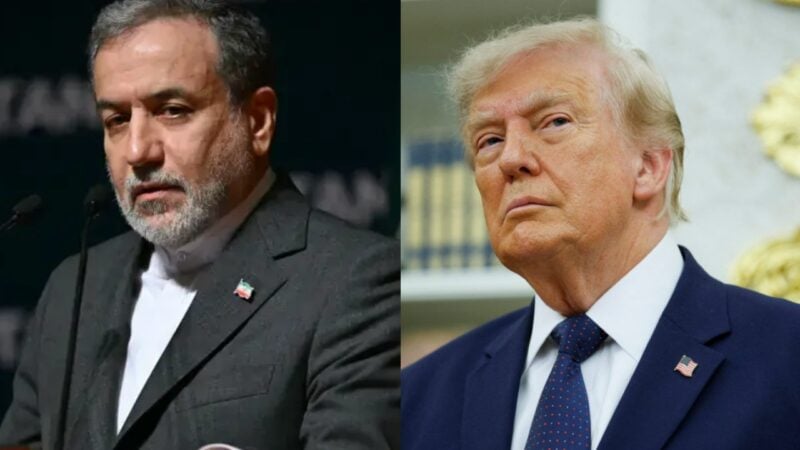
United States (US) President Donald Trump announced that the United States will charge a 20 percent fee on all commercial cargo transiting the Strait of Hormuz. The announcement comes alongside a decision to reinstate a military blockade on Iranian ports, escalating the conflict between Washington DC and Tehran.
“The U.S.A. will be, from this point forward, known as ‘THE GUARDIAN OF THE HORMUZ STRAIT,’ but as such, and as a matter of FAIRNESS, will be reimbursed, at the rate of 20% on all cargo shipped, for any and all costs necessary to do the job of providing safety and security to this very volatile section of the World,” Trump wrote on Truth Social on Monday.
He added that “The process and formation will begin immediately.”
US Central Command (CENTCOM) confirmed the blockade on Iranian ports near the waterway will resume on Tuesday.
Speaking to reporters at the White House on Monday afternoon, Trump said, “We’re attacking them tonight, and we’re taking out all of their capability for anything having to do with the strait.” He added, “And I think in the end, we will end up controlling the whole thing.”
In a television interview on an international media outlet, Trump stated, “We’re going to keep the strait, and we’ll probably run it.” He told the outlet, “We’ll become the guardian of the strait, maybe we’ll call it the guardian angel of the strait,” and, “And we should be reimbursed for that.”
He further stated, “We can’t be expected to do that for nothing, unlike we had for many years,” and, “We guarded it for nothing, and now we’re going to guard it, we’re going to get paid for guarding it. A lot of money.”
Iranian Foreign Minister (FinMin) Abbas Araghchi responded on X, rejecting the US claim to the role while endorsing the principle behind it. “POTUS is absolutely right. Whoever provides secure and safe passage of commercial vessels through the Strait of Hormuz should be compensated for this service,” he wrote, adding: “Iran has always been the guardian of the strait and will remain so forever.”
On the fee itself, Araghchi wrote: “20% is of course too much. We will be fair.”
The dispute unfolds against the backdrop of a collapsed ceasefire. A truce signed between the US and Iran in mid-June had explicitly barred Tehran from imposing charges on commercial ships passing through the strait, but Trump declared the ceasefire “over” last week following renewed strikes between the two sides.
Days after the ceasefire was first signed, Trump had already floated the fee idea, writing there would be no tolls “unless they are imposed by and for the United States of America, should the deal not be completed, for services rendered as the Guardian Angel to the countries of the Middle East for purposes of both past, present, and future reimbursement of costs.”
Legal and industry experts have questioned the plan.
James Kraska, professor of international maritime law at the US Naval War College, said Iran’s past attempts to charge similar tolls were “not permitted under international law,” but that Trump’s proposal could be read differently: “We’re going to convoy vessels through here, and if you want to join, here’s the cost.”
He said that framing would be lawful since it is voluntary, though he added that being lawful “doesn’t mean he’d necessarily advise it.”
John McCown, senior fellow at the Center for Maritime Strategy, told an international media outlet that shippers would first need clarity on cost before deciding whether to use the service, noting it remains unclear how the fee would be calculated.
The United Nations (UN) reiterated its own position separately. Asked whether Secretary-General Antonio Guterres accepts that any member state can impose a fee on cargo passing through the strait, UN spokesperson Stephane Dujarric said: “The secretary-general’s position has been consistent … he wants to see freedom of navigation in the Strait of Hormuz.”