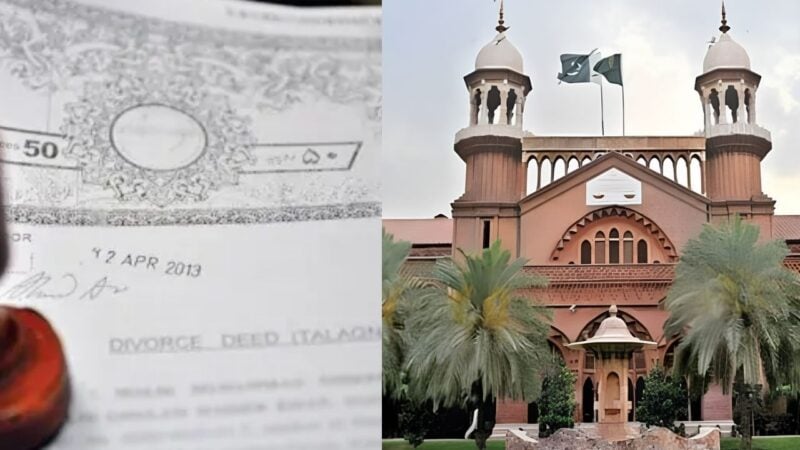
The Lahore High Court (LHC) has ruled that a husband cannot seek the return of gold ornaments mentioned as dower in a Nikahnama as compensation for Khula obtained by his wife.
Justice Raheel Kamran issued the ruling while deciding four petitions linked to a matrimonial dispute between Dr Rukhsana Kausar and Shahid Nazeer.
The petitions challenged findings by a Muzaffargarh sessions court on several issues, including gold ornaments, maintenance, dowry and ownership of the couple’s house.
The couple’s marriage ended through Khula in 2012. The family court initially ruled that the wife had to return the dower she received as Badl-i-Khula (compensation for khula), while disputes over maintenance, dowry articles, gold ornaments and delivery expenses continued.
In 2018, the family court partly accepted the suit, awarding maintenance and ordering the recovery of dowry articles. It also directed the wife to return 11 tolas of gold or its equivalent value to her husband.
The appellate court upheld the decision in 2020, changing only the annual increase in maintenance for the minor child from 15 percent to 10 percent.
On the maintenance issue, Justice Kamran upheld the earlier decisions, noting that the husband had not submitted his complete salary record and had only provided a certificate showing his basic pay.
The judge said that the courts could therefore draw an adverse inference about his actual earning capacity.
Justice Kamran also noted that the husband’s brother had testified that he owned a Honda Civic. The court said that this further weakened the husband’s claim that he had limited financial means.
The judge held that a “financially capable parent” could not understate his resources to reduce his financial responsibilities towards his child.
On the ownership of the matrimonial house, the court upheld the finding that the wife’s father, who was working abroad at the time, had paid for the entire purchase.
The payments were supported by a documented chain of banking transactions, which bank officials also verified. Their evidence largely remained unchallenged during cross-examination.
The judge held that the husband had never paid for the house despite its mention in the dower. Therefore, he could not seek its return as Badl-i-Khula.
The court also upheld the wife’s later transfer of the house to her father and the decree giving him possession.
On the claim involving 11 tolas of gold, Justice Kamran said that the lower courts had erred by relying on the lack of documentary evidence while failing to consider other circumstances supporting the wife’s position.
The judge noted that the husband’s financial incapacity had already been established and said it was more likely that the wife’s father had financed the gold as well.
“Consequently, the respondent cannot claim return of the said ornaments as Badl-i-Khula,” the judge held, as the ornaments did not constitute dower that the husband had financed or paid for from his own resources.
However, the court upheld the findings against the wife concerning 22 tolas of dowry gold.
The judge noted that the wife had never claimed that the jewellery was forcibly taken from her. The court also considered her differing accounts about when she left the matrimonial home.
Her refusal to produce a video from her sister’s wedding, which could have shown her wearing jewellery after leaving her husband’s home, also led the court to draw an adverse inference.
Justice Kamran also upheld the dismissal of the wife’s claim for Rs63,000 in maternity and delivery expenses.





