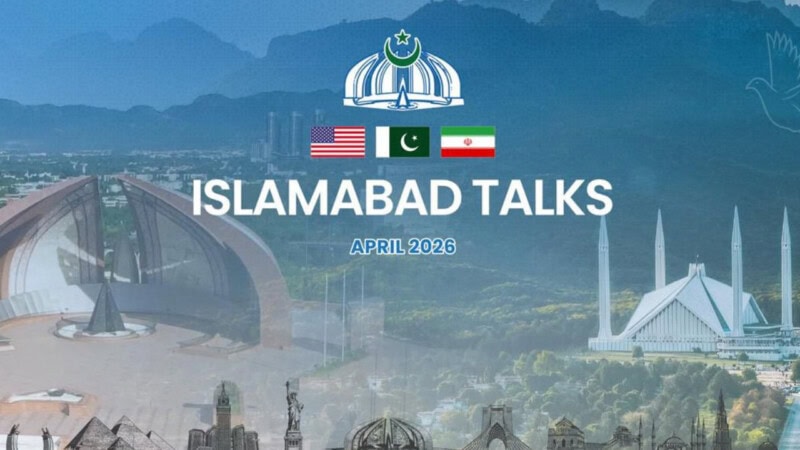
Billboards across Islamabad recently became the center of a cross-border debate, but not for reasons typical of regional friction. As Pakistan hosted high-stakes peace talks involving officials from Iran and the United States (US), the roads of the capital were lined with hoardings featuring the Faisal Mosque, the Pakistan Monument, and the flags of the three nations.
Noticeably absent from the displays were the faces of Prime Minister (PM) Shehbaz Sharif or Chief of Defence Forces (CDF) Field Marshal Asim Munir. There were no party colors, no PML-N lions, and no celebratory slogans marking the event as a political victory before it had even concluded.
The minimalist branding triggered a wave of reactions from Indian social media users, many of whom used photos of Islamabad to critique the political culture in their own country.
Observers from across the border noticed that the usual political faces were missing. They pointed out that this was a big change from the leader-focused branding they see constantly in India under Indian Prime Minister Narendra Modi.
“Pakistan could learn so much from our megalomaniac leaders and their mob of sycophants,” one user remarked sarcastically, noting that the focus remained on the city and the state rather than the individual in power.
Another post highlighted the contrast in branding: “He could have sent them his photos big miss. I still can’t believe that Modi ji had put his photo on the Covid vaccine certificates.”
The critique often took a sarcastic tone, with users mockingly calling Pakistanis “low-IQ” for failing to utilize the event for domestic political gain. “No PM photo on every billboard, only the country flag. No celebration as a Masterstroke before any results,” one viral post noted, taking an indirect jab at the Indian government’s tendency to frame diplomatic events as personal triumphs for Modi.
The comments from Indian critics showed a clear preference for branding that focuses on the state rather than a single leader or political party. “Peace in a country isn’t brought by one PM or any single individual; it comes from the nation as a whole,” one commentator wrote. “Political parties have no identity without the country itself”.
Pakistani users were quick to respond to the sudden influx of commentary, defending the understated approach as a sign of institutional maturity. “You Indians have been taught that ‘Loud’ equals ‘Strong.’ But Islamabad is currently proving that ‘Quiet’ equals ‘Credible,'” one Pakistani user replied.
The conversation shifted toward the purpose of diplomacy versus the mechanics of an election cycle. As one Pakistani observer put it, “No party symbols, no chest-thumping, just the national flag and a blue theme. It’s almost like they want the world to focus on the Peace Deal instead of the Election Cycle.”
While Indian users expressed frustration with what they termed “cheap tactics” and “small men in big offices,” the response from the other side remained focused on the state. “Pakistan was hosting the talks, so the flag was enough to display since it represents the state,” a Pakistani user concluded.