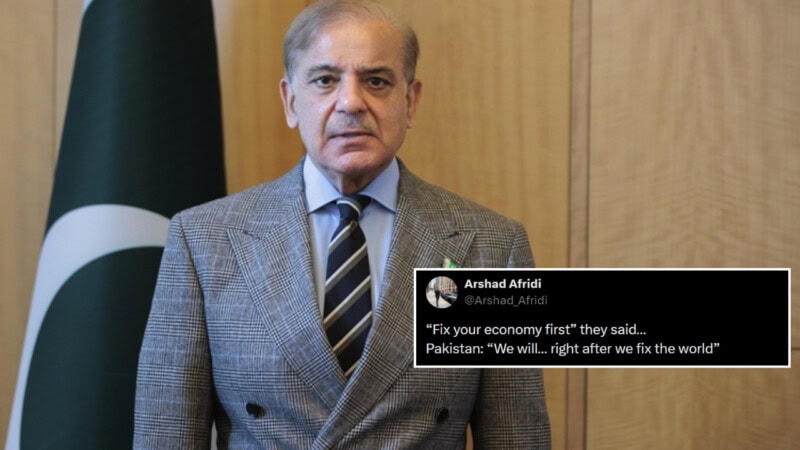
Prime Minister (PM) Shehbaz Sharif early Wednesday said that the United States (US) and Iran had agreed to an immediate ceasefire, days after Islamabad proposed a two-week diplomatic pause and invited both sides for talks.
In a post on X, the premier said both countries, “along with their allies have agreed to an immediate ceasefire everywhere including Lebanon and elsewhere, effective immediately”.
He also invited delegations from Washington and Tehran to Islamabad on April 10 for negotiations aimed at a “conclusive agreement to settle all disputes”.
The development followed a late-night proposal from Islamabad wherein PM Shehbaz urged President Donald Trump to extend his deadline for Iran by two weeks while asking Tehran to reopen the Strait of Hormuz for the same period.
“We also urge all warring parties to observe a ceasefire everywhere for two weeks to allow diplomacy to achieve conclusive termination of war,” he wrote.
Trump confirmed the arrangement shortly before the expiry of his deadline, saying the agreement was contingent on Iran halting restrictions on the Strait of Hormuz. Iranian Foreign Minister Abbas Araqchi said that Tehran would stop counter-attacks if strikes ceased, and will ensure safe passage through the waterway.
“This will be a double-sided CEASEFIRE,” Trump wrote in his post on Truth Social, adding that the US had “met and exceeded all military objectives” and was moving toward a broader agreement.
Iran’s Supreme National Security Council said that the ceasefire followed what it described as the acceptance of its conditions. “It was decided that negotiations will be held in Islamabad to finalise the details,” the council said, adding that outcomes would be settled through talks within 15 days.
The White House also described the development as a result of US military leverage, with Press Secretary Karoline Leavitt saying that it had created “an opening for a diplomatic solution”.
The conflict, now in its sixth week, has resulted in more than 5,000 deaths across multiple countries, according to official estimates and rights groups.
Islamabad had been in contact with multiple capitals since the conflict began, building support for a ceasefire to create space for talks. The proposed framework centred on a pause in hostilities and confidence-building steps, including de-escalation around key maritime routes.
The next phase is expected to begin in Islamabad on April 10, where delegations will take up the structure of a longer-term arrangement.
Many netizens took to social media to process the reality of their country often criticised for its economic struggles stepping in to stop a potential third world war.
“Pakistan out here trying to fix global peace….the least the world can do is unlock visa free travel for us! [sic]” one user noted, while another quipped, “‘Fix your economy first’ they said Pakistan: ‘We will right after we fix the world.’”
The role of the military leadership also drew significant commentary as Chief of Defence Forces (CDF) Field Marshal Asim Munir reportedly held direct conversations with senior US officials to reinforce civilian efforts.
This prompted several public apologies from former skeptics. One commentator wrote, “I thought Pakistan couldn’t bring powerful Muslim countries together to form a pact given its current state; Asim Munir proved me wrong… I owe you an apology, Field Marshal.” Another said, “Lots of people owe our dear hafiz sahab an apology.”
Journalist Mahwish Ajaz captured the triumphant mood, suggesting, “We need a remix of Miyan De Naaray & General Asim Munir Meri Jind Meri Jaan to play rn.”
Despite the gravity of the ceasefire, the Pakistani internet maintained its characteristic wit. Some users joked about the domestic impact, with one saying, “Strait of Hormuz, university road sy pehly khul gaya.”
As Islamabad prepares to host the April 10 negotiations, the sense of a shifted narrative is palpable.
“Pakistan has become the MOST RESPONSIBLE NUCLEAR State in the world,” read one post, reflecting a sentiment shared by many who feel the country has finally “built the table” rather than just asking for a seat.
For a nation used to being on the receiving end of international pressure, the sight of Sky News, CNN, and the BBC repeating the names of Pakistani leaders in a positive light marked a rare moment of global validation. One user summed up the surreal timing by referring to PM Shehbaz Sharif as the first “Laptop Uncle” in their bloodline to stop a nuclear war.
Even the traditionally tense relationship with the IMF wasn’t spared, as one person joked that point 7 of the agreement should be the “entire IMF management team singing the Pakistan national anthem at Minar-e-Pakistan as an apology”.