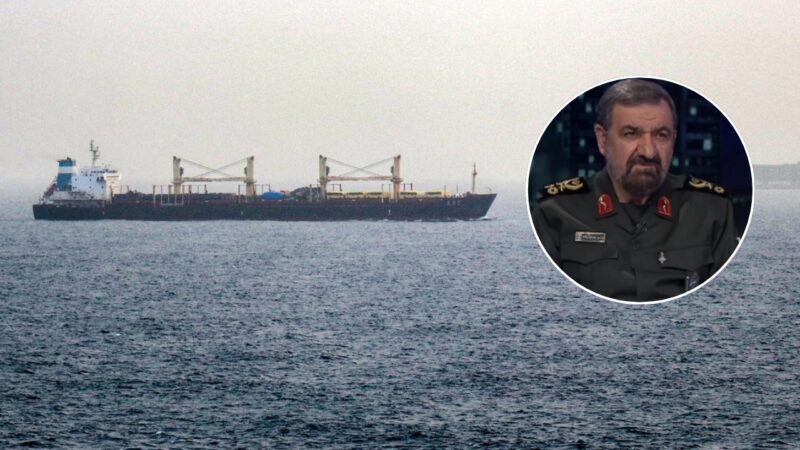
Iran cancelled plans to launch strikes against three sites in Ukraine following an apology from Kyiv, Mohsen Rezaei, military adviser to Iranian Supreme Leader Ali Khamenei, has confirmed.
Rezaei said during an interview with Iranian state television that Iranian armed forces completed preparations for the strikes before the leadership called off the operation. The decision followed accusations from Iran on July 25 that Ukraine attacked an Iranian commercial vessel in the Caspian Sea, killing one crew member.
Rezaei also issued a warning for naval traffic through the Strait of Hormuz, stating that Iran will restrict maritime transit to Iranian-designated routes, adding that “any hostile naval vessel attempting to use an ‘illegal route’ would be targeted.”
He further stated that Iranian forces inflicted losses on United States (US) forces during the 17-day conflict, adding that missile and drone strikes blocked Washington’s military objectives.
Concurrently, the United Kingdom Maritime Trade Operations (UKMTO) reported an incident 20 nautical miles (37 kilometres) northeast of Al Khasab, Oman, where an unknown projectile struck a cargo vessel. Authorities opened an investigation into the attack.
Shipping traffic across Gulf waterways maintained volumes despite tension. Kpler shipping data showed 20 vessels, including 12 tankers and eight bulk carriers, crossed the Bab el-Mandeb strait on Monday, matching the previous day’s traffic with 12 exits and eight entries.
Iranian Foreign Minister Abbas (FM) Araghchi held phone discussions with Omani Foreign Minister Badr AlBusaidi on Monday to discuss regional developments. Oman and Iran held negotiations to establish a maritime route through the Strait of Hormuz along territorial waters.
Iran’s Ground forces commander of the Islamic Revolutionary Guard Corps (IRGC), Mohammad Karami, posted on X that troops at the Hamzeh Seyyed al-Shohada Headquarters in northwestern Iran maintain readiness for any “miscalculation by extra-regional enemies or terrorist groups.”
Karami stated that the forces stand ready to “deliver a decisive response to any threat.”
In Washington, US President Donald Trump addressed the conflict, asserting that talks continue between the two nations. “We have many talks, they deny it. But they’re not denying it now,” Trump told reporters in the Oval Office.
“When they’re talking, they don’t like saying that we’re talking. The talks are going along. We were to hit them very hard yesterday and they called, Iran did not want to be hit. They said ‘we want to talk’,” Trump added, noting that calls were held with Saudi Arabia, the United Arab Emirates, and Qatar.
Trump warned Iran regarding a settlement, stating, “This is the last chance for them to sign a good document.” He added that Iran faces “decapitation” without an agreement. “I think we’re going to maybe get something, but I want to give them every last chance before decapitation,” Trump claimed.
Regarding maritime transit, Trump stated that negotiations will reopen the Strait of Hormuz.
“It’s not very complex. We’re talking about the opening of the Strait of Hormuz and having it open, literally, by tomorrow, completely open.”
Trump rejected Iranian plans to collect fees from passing ships. “I’m not going to let them charge,” Trump told reporters. “If anybody’s going to charge, we’re going to charge, we have total control. We’re not talking about charging at all.”
Trump also criticized oil firms regarding market prices caused by crude shortages from the war. “I don’t like it. They’re making too much money, okay? Based on a shortage, they’re making too much money,” Trump observed.
Following Iranian statements denying direct negotiations, Trump posted on Truth Social, calling Iranian leadership “unbelievably duplicitous.”
Meanwhile, US Central Command (Centcom) stated that US naval forces operating the blockade redirected 44 commercial vessels, disabled two vessels, and boarded two others.
Crude oil markets responded to negotiation prospects as West Texas Intermediate (WTI) dropped 6.1 percent to $79.5 per barrel, while Brent North Sea Crude fell 4.7 percent to $83.84 per barrel.