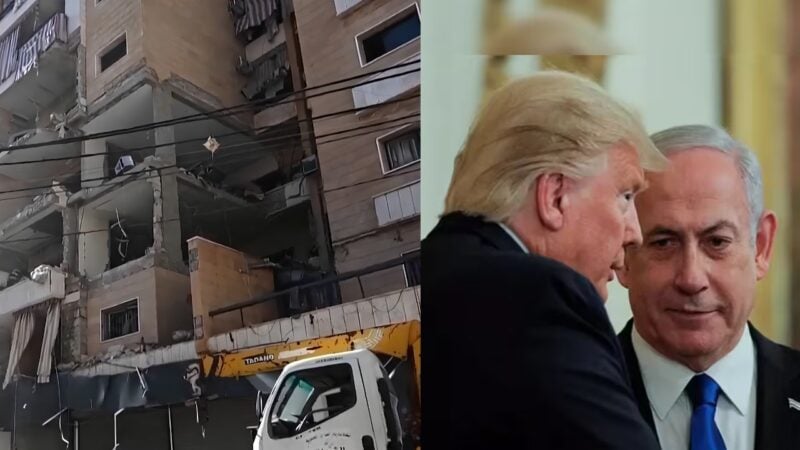
United States (US) President Donald Trump has stated that Israeli Prime Minister Benjamin (PM) Netanyahu will have “no choice” but to accept an upcoming deal with Iran, asserting that the US “calls all the shots”.
The remarks came after a sharp escalation in military clashes in the Middle East, during which Israel and Iran exchanged direct military strikes, threatening a fragile regional truce established in early April that Israel has repeatedly violated.
The latest flare-up began after Israel conducted air strikes on Beirut, Lebanon.
Israel defended the operation as a necessary response to Hezbollah firing toward its territory. In retaliation for the Beirut bombings, Iran launched a salvo of 11 ballistic missiles toward Israel on Sunday, targeting the Ramat David air base near Nazareth.
The Israeli military reported that its aerial defense systems successfully intercepted all 11 missiles, resulting in zero casualties. Additionally, a missile launched from Yemen toward Israel was intercepted, marking the first attack from Yemeni territory since April 8.
Following the initial Iranian barrage, Donald Trump held a 30-minute phone call with Netanyahu from Bedminster, New Jersey, urging him to refrain from military retaliation.
Speaking to Axios, Trump stated, “I am going to call Bibi right now and tell him not to retaliate. Each of them had their fun. Israel had its strike, and Iran had its strike. We don’t need another one”.
Trump minimized the impact of the initial bombardment, noting that “the Iranian strikes didn’t hurt anybody,” and warned that further counter-strikes would prolong a conflict that has lasted “the last 47 years or the last 3,000 years”.
Trump dismissed the idea that the regional escalation would derail ongoing diplomatic negotiations led by US Vice President JD Vance since April. “It’s not going to have any impact on the deal,” Trump told the Financial Times. “I call the shots. I call all the shots. He [Netanyahu] doesn’t call the shots”.
Trump indicated that if the diplomatic route fails on its merits, the US would consider a military commando raid or maintain its powerful maritime blockade on Iranian ports. The US President also acknowledged a leaked phone call reported by Axios, where he used obscenities to rebuke Netanyahu’s recent decisions.
Despite Trump’s warnings, the conflict intensified on Monday morning. The Israeli military announced it had detected a sixth wave of incoming Iranian missiles targeting the country. The Islamic Revolutionary Guard Corps (IRGC) claimed responsibility for this fresh wave, stating they targeted Israel’s Nevatim and Tel Nof air bases in response to Israeli strikes on Iranian radar installations.
Simultaneously, the deputy governor for security of Iran’s Khuzestan province confirmed that an Israeli projectile struck and damaged the Karun petrochemical plant near the southwestern city of Bandar-e-Mahshahr.
In response to the multi-day escalation, Israeli Army Radio reported that the military expects the direct exchange of fire to last several days and is actively preparing for a large-scale mobilization of reserve battalions.
Meanwhile, Iran’s foreign ministry spokesperson, Esmaeil Baqaei, stated during a live press conference that the US holds “direct responsibility” for the ceasefire breaches, arguing that the actions of the “Zionist entity” cannot be separated from Washington’s broader policies.
Diplomatic tracks remain complicated by conditions on the ground. Iran’s chief peace negotiator and Parliamentary Speaker, Mohammed Baqer Qalibaf, declared that US bases and Israeli assets remain legitimate targets due to the “violation of agreements over Lebanon”.
Tehran maintains that a permanent Israeli ceasefire in Lebanon is a mandatory precondition for any final US-Iran deal.
Conversely, Israeli officials insist that its illegal occupation of Lebanon must be handled entirely separate from any truce with Iran.