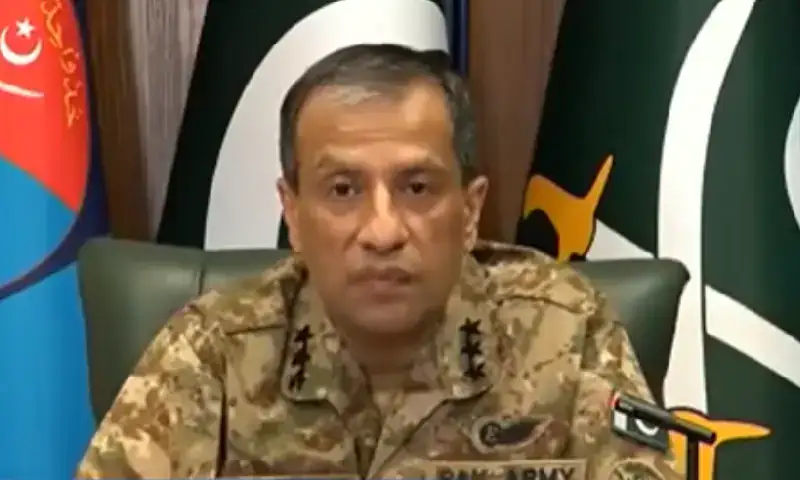
Inter-Services Public Relations (ISPR) Director General Lieutenant General Ahmed Sharif Chaudhry has said that the Makkah Defence Alliance between Pakistan, Saudi Arabia and Turkiye is focused on collective deterrence and has no regional aspirations, describing the agreement as complementary to the three countries’ existing international relationships.
Speaking to Al Arabiya English’s ‘Global News Today’, Lt Gen Chaudhry said that the tripartite agreement formalised Pakistan’s decades-old relationship with Saudi Arabia and its ties with Turkiye in the areas of collective deterrence and defence.
Asked whether the pact marked the start of a broader strategic alliance, he said the agreement remained defensive in nature.
“It is defensive. There’s nothing aggressive. There are no regional aspirations. It is collective deterrence,” he said.
He added that the agreement was “complementary” because Pakistan, Saudi Arabia and Turkiye each maintained independent relationships with other countries, blocs and alliances. “So this mutual defence agreement is complementary in nature. It is not competing with any other relationship of these countries,” Lt Gen Chaudhry said.
The military spokesperson also addressed whether the pact contains a mutual defence obligation and how the three countries would respond if one member came under attack.
He stated that the publicly released text of the agreement made the mutual defence commitment clear, but the operational details of how the countries would respond would remain classified. “You see, you have multiple other agreements which are defensive in nature, which are committal in nature. But no country comes out and starts sharing its operational details,” he said.
Lt Gen Chaudhry added that the specific manner in which the three countries would implement their defensive commitments would be decided by the members themselves.
He was also asked whether the alliance could compete with Pakistan’s relationship with China. Lt Gen Chaudhry said it would instead compliment Islamabad’s ties with Beijing, pointing to the longstanding nature of Pakistan’s relationships with Saudi Arabia and Turkiye.
“The Chinese understand it. The world at large understands it, that how historic these relationships are. We have formalised that,” he said.
He added that the three countries also maintain good relations with China and said that the agreement was intended to support regional stability and peace.
The interview also covered whether the defence pact could form part of a wider security arrangement involving Muslim-majority countries. Lt Gen Chaudhry said that the agreement does not describe itself as a Muslim alliance.
“It is not a club that is being made for only Muslim countries,” he said, adding that the alliance could potentially include other willing partners that share its stated principles of regional peace, stability and security, non-aggression, non-interference and collective deterrence.
He stated that any decision about expanding the alliance would rest with the leadership of Pakistan, Saudi Arabia and Turkiye.
The three countries signed the joint defence pact on Aug 7. The agreement states that an attack on one member would be treated as an attack on all. Its inaugural meeting took place in Istanbul on Aug 31, where the three countries decided that Pakistan would initially lead the alliance’s secretariat for three years.
Discussions about expanding the alliance have continued since its signing, with Turkiye initially suggesting that Egypt could join, although Cairo has not confirmed any such move.
Prime Minister (PM) Shehbaz Sharif and Deputy Prime Minister (DPM) and Foreign Minister (FM) Ishaq Dar had also described the pact as defensive after its signing. Dar said that the agreement was open to countries in the region that were willing to uphold its principles.