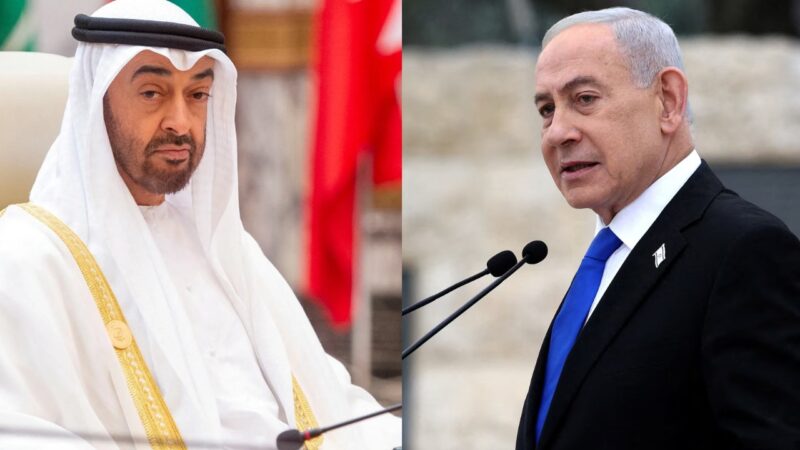
Hours after Israeli Prime Minister (PM) Benjamin Netanyahu’s office claimed he secretly visited the United Arab Emirates (UAE) and met with President Sheikh Mohammed bin Zayed Al Nahyan during the conflict with Iran, Abu Dhabi has issued a statement denying the same.
According to the Israeli PM office, Netanyahu “paid a secret visit to the UAE” during the war, describing the meeting as a “historic breakthrough in relations between Israel and the UAE”.
While the claim surfaced shortly after United States (US) Ambassador to Israel Mike Huckabee confirmed that Israel dispatched Iron Dome air-defence systems and personnel to the UAE during the clashes, the UAE Foreign Ministry has released a formal statement contesting these accounts.
“The UAE denies reports circulating regarding an alleged visit by Netanyahu to the UAE, or receiving any Israeli military delegation in the country,” the ministry said, further clarifying that its relations with Israel were public and “not based on non-transparent or unofficial arrangements”.
The statement emphasised that any claims of unannounced visits or undisclosed agreements were “entirely unfounded” unless officially confirmed by Emirati authorities.
The claim also drew a sharp reaction from Tehran as Iranian Foreign Minister Abbas Araghchi said that Netanyahu had “publicly revealed what Iran’s security services long ago conveyed to the leadership”.
Writing on X, Araghchi called enmity with Iran a “foolish gamble” and described the alleged collusion with Israel as “unforgivable”. He added that those seeking to sow division would be held accountable.
The UAE was a primary target for Iranian strikes during the war, which began following US-Israeli strikes on Tehran in February. Despite a ceasefire established last month, the UAE has continued to report missile and drone attacks originating from Iran – a claim denied by Tehran.
Public reaction to the conflicting reports has been polarised as some observers labeled the situation a “clown show”, while others noted that the UAE’s phrasing and denying what is being “circulated” is not necessarily a blanket denial that a meeting took place.
One commentator suggested that even the UAE Ministry of Foreign Affairs staff may have been unaware of the meeting initially, leading to the conflicting reports.
The timing of the Israeli announcement has also been questioned. Critics pointed out the contradiction of “announcing” a “secret” meeting, with some suggesting the move was intended to provoke or instigate tension.
Others viewed the development as a sign that the geopolitical implications of backchannel meetings during the conflict were becoming increasingly difficult to manage.
Some users also noted that Iran’s pressure had left the UAE in a difficult position, suggesting the denial was a defensive move.
“Can’t decide which one of them is the real liar,” wrote a netizen while others highlighted the historical precedent of a state announcing a prime ministerial visit only for the host nation to officially deny it.