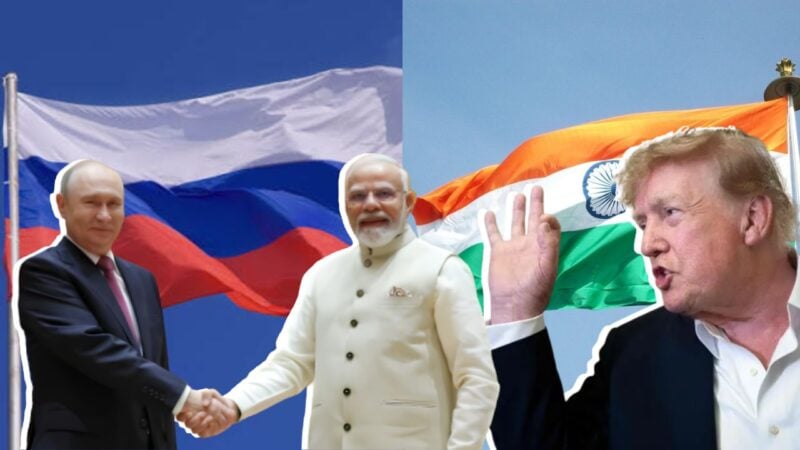
The United States (US) House of Representatives has passed legislation giving President Donald Trump authority to impose tariffs of up to 100 percent on countries that purchase Russian oil and gas.
On Wednesday, the bill cleared Congress and now awaits Trump’s action. India and China are among the countries most exposed because of their large purchases of Russian crude.
India’s reliance on discounted Russian crude, which helped lower its oil import costs after Russia’s invasion of Ukraine, is now creating a new economic risk as the United States (US) moves to penalise countries that continue buying Russian energy.
For the past four years, Russian crude displaced from Western markets has increasingly flowed to Indian refineries, often at discounted prices. The arrangement gave Indian refiners a major source of crude while helping reduce the cost of one of the country’s biggest imports.
Russia supplied 30.3 percent of India’s crude imports in fiscal 2026, worth $40.8 billion out of a total crude import bill of $134.7 billion, according to the Global Trade Research Initiative (GTRI). In July, Russian crude made up more than half of India’s crude imports.
Other major suppliers accounted for much smaller shares. The United Arab Emirates (UAE) supplied 10.8 percent, Saudi Arabia 9.6 percent, Venezuela 6.3 percent, Brazil 5.5 percent, Oman 5.3 percent and the US 2.9 percent of India’s July crude imports.
Between December 2022 and August 2026, China accounted for around half of Russia’s crude exports, followed by India at 37 percent, Turkey at 5 percent and the European Union at 5 percent, according to the Centre for Research on Energy and Clean Air (CREA).
GTRI’s Ajay Srivastava, a former Indian trade official, argued that India’s purchases were driven by its need for affordable energy.
“The bill is a blunt and dangerous attempt to pressurise India to sign the bilateral trade agreement on one-sided terms. India buys Russian oil to secure affordable energy for 1.4 billion people, not to finance war, and these purchases have helped stabilise global supplies and prices,” he said.
However, the economics of Russian crude have changed since the early years of the war. Discounts have narrowed, while competition for Russian barrels and the costs linked to shipping, insurance and sanctions have increased.
After the US House passed the legislation, Democratic Senator Richard Blumenthal warned India and China against continuing to buy Russian energy.
“China and India, you better buy your oil and gas somewhere else,” he told reporters.
The legislation would normally give countries 180 days to reduce their Russian energy imports or negotiate with Washington, although the president could shorten the deadline.
India said that it was “monitoring further developments on this matter” and remained “firmly committed to ensuring energy security” for its people.
“This issue has been discussed at high levels in recent months with various US interlocutors. Its potential implications for not just the bilateral relationship but also the international energy market have been very clearly articulated by the Indian side,” it added.
India can turn to other suppliers, but replacing Russian crude at the same scale could increase crude, freight and insurance costs. S&P Global has noted that alternative supplies can also involve longer shipping routes, adding to the overall cost.
The potential US tariff would also affect India beyond its energy sector. The measure would target Indian exports to the US rather than directly taxing Russian crude entering India.
The US imported around $104 billion worth of goods from India in 2025, while two-way trade in goods and services stood at roughly $240 billion, according to the US Trade Representative.
Indian exports to the US include electronics, pharmaceuticals, machinery, jewellery, chemicals, textiles and petroleum products. Electrical and electronic equipment accounted for around $25.8 billion of Indian exports to the US in 2025, followed by pharmaceuticals at about $9.7 billion and machinery at around $7.2 billion.
The latest threat follows an earlier round of US tariffs on Indian goods that reached 50 percent in 2025 before being reduced.