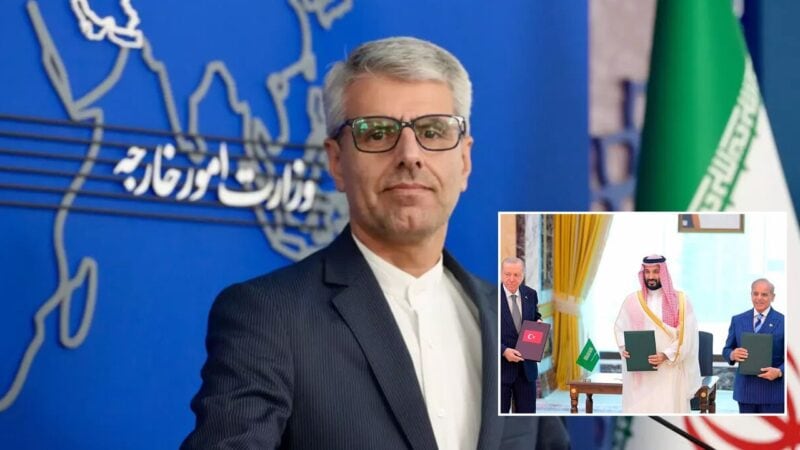
Iranian foreign ministry spokesperson Esmaeil Baqaei on Monday said there was “no reason to worry” that the Makkah Joint Defence Agreement between Pakistan, Saudi Arabia and Turkiye will be used against Tehran.
The defence agreement, signed on Friday in Makkah, aims to strengthen deterrence by allowing member states to treat an attack against one state as an attack against all member states.
Speaking during a press briefing on Monday, Baqaei addressed queries regarding the agreement and pointed to historical, religious and civilisational ties connecting Iran with all three member states.
Baqaei said that the agreement reflects “a sign of a change in the perception” among governments across the region regarding foreign security guarantees.
“Considering the developments of the last two to three years, the countries of the region have realised that security is not a commodity that can be bought from false security brokers,” Baqaei said in an apparent jibe at the United States (US).
He said that the development shows regional nations “have concluded that they cannot rely on and trust the claim of security provided by the US and some other actors outside the region”, adding that they were attempting to try another method by relying on their own capabilities and perspectives.
Baqaei also described the US as a cause of insecurity in the Middle East. He stated that security plans based on the realities of the region and inclusive cooperation offer a way to strengthen security and prevent instability or actions by Israel and allies of Israel.
When asked about Iran joining the defence agreement, he stated that Iran has always “emphasised pursuing security mechanisms based on cooperation between regional countries” while remaining “free from the influence and destructive intervention” of foreign actors.
The Iranian foreign ministry spokesperson added that regional security frameworks proposed by Iran “still exist and can certainly be updated in light of developments”.
“We are in close contact with neighbouring countries and regional countries, and we hope that all countries will learn from the developments of the last two or three years and adopt the best path to strengthen the region’s collective security,” Baqaei said.
He also addressed invitations from Pakistan for Parliament Speaker Mohammad Bagher Ghalibaf and Foreign Minister Abbas Araghchi to visit Islamabad.
“This visit will take place whenever the time is right,” Baqaei stated, adding that the relationship between Islamabad and Tehran was a very important one.
“In the last seven or eight months, it has become even more important than before, for various reasons.”