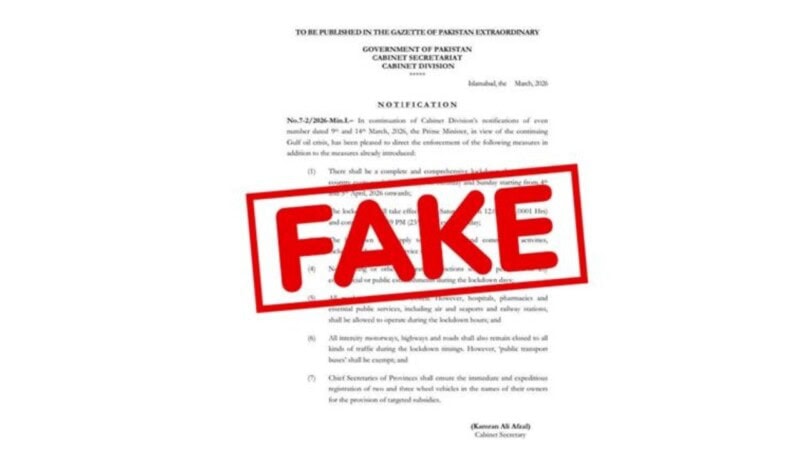
The federal Ministry of Information and Broadcasting (MoIB) has rejected a notification circulating on social media claiming that a nationwide weekend lockdown will be imposed in the country, stating that the document is fake.
In a post on its official fact-check account on X, the ministry stated that the viral notification was “fake” and urged users not to spread misinformation.
“Avoid sharing fake news and false posts. Be a responsible citizen and only trust verified sources,” the post read.
The undated document falsely attributed instructions to Prime Minister (PM) Shehbaz Sharif, claiming a lockdown was being imposed due to a “continuing Gulf oil crisis”.
It stated that a “complete and comprehensive lockdown throughout the country” would be enforced every Saturday and Sunday starting April 5.
“The lockdown shall take effect every Saturday from 12:01am and continue till 11:59pm every Sunday,” the document read.
No such notification has been issued by the government.
However, officials indicated that a plan related to energy conservation is under consideration, which may include a nationwide smart lockdown and other measures, though no decision has been announced.
Under the proposal, markets and shopping malls may close at 9:30pm, while wedding halls could be limited to 200 guests with a one-dish policy and a 10pm closing time.
A 50 percent rota system is also under consideration, along with digital attendance monitoring and weekly audits. Similar arrangements may apply to private offices, including up to 50 percent remote working.
Measures being reviewed also include restricting the use of air conditioners in government offices before 10:30am and shifting public sector buildings to solar energy within 60 days.
Earlier, Prime Minister Shehbaz Sharif had announced austerity steps following a fuel shortage linked to tensions in the Middle East after attacks by the United States and Israel on Iran.
The measures included a four-day work week, work-from-home policy, and a 50 percent cut in fuel allocation for government vehicles.
Cabinet members, advisers and special assistants were directed not to draw salaries for two months, while salaries of members of parliament were reduced by 25 percent. Expenditures of government departments, excluding salaries, were also cut by 20 percent.