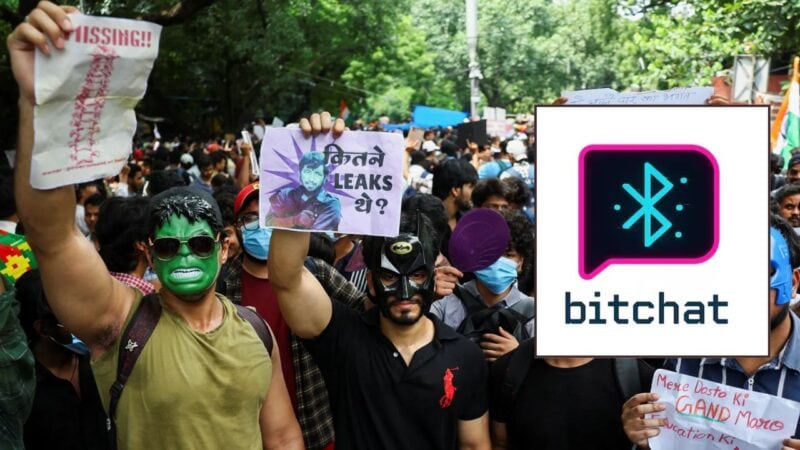
Outrage erupted across social media platforms after the Indian government directed developer platform GitHub to block access to Bitchat, an offline messaging application, citing security risks and potential misuse by criminal groups.
Former Twitter Chief Executive (CEO) Jack Dorsey shared the order issued by the Indian Cyber Crime Coordination Centre (I4C), an entity that works under the Ministry of Home Affairs, on social media. The directive gave GitHub three hours to remove access to three code repositories linked to the platform.
Authorities invoked Section 79(3)(b) of the Information Technology Act alongside Rule 3(1)(d) of the IT Rules, 2021. Official notices noted that the setup of Bitchat prevents law enforcement from intercepting, tracking, or investigating communications.
The move follows repeated mobile internet suspensions around New Delhi’s Jantar Mantar, where students have been protesting over examination paper leaks. Authorities issued six shutdown orders over five days, restricting mobile internet within a 1.5-kilometre radius of the demonstration venue until Friday midnight. People aware of the situation noted that extension orders past July 24 midnight were not issued as of Friday evening.
Protesters turned to Bitchat to maintain communication during network blackouts. Bitchat operates as a peer-to-peer service through Bluetooth Low Energy mesh networks. The application functions without cellular coverage, internet access, or phone registration, allowing devices located 30 to 100 metres apart to relay messages directly to nearby phones.
The directive sparked furious reactions online, with users pointing out the technical difficulty of censoring open-source software.
“I think they don’t know that once something is on the internet, it is IMPOSSIBLE to ban it!” wrote one user.
Others threatened to boycott the hosting platform if it acceded to the demand, emphasizing that the tool served peaceful public demonstrations rather than anti-state activities.
“WTF if github do this i never use it after that bitchat people use to communicate in protest it is protest about education system reform not about anti current government something like we just want our human right,” stated another person.
Concerns over regulatory overreach and democratic norms dominated public discussion. “Wonder how many other projects are next if this becomes normal,” noted one user. “And yes this is so called democracy to suppress people’s voice,” remarked another netizen.
“Ghost this Goverment these guys think people forget things with time so prolly treat them the same,” wrote a social media user.
“Indian government crossed the limit with this , first telegram now bitchat , its wrong that some goon who is not qualified for his role can watch activity of anyone anytime,” stated one individual.
“I mean now this is beyond acceptable, the only means after internet is shut down is apps like bitchat etc. now they want to disable that as well, I mean this is totally nonsense move in the first place,” expressed another user.
“Do not call India democratic country, it is in dictatorship,” one opinion said.
“A cowardly action to suppress people from sharing the reality of ongoing protest in delhi. After that they can just say the protest turned violent and the protesters attacked the police,” highlighted one individual.
“At this point the government is just embarrassing us at a international stage. First banned telegram and now this,” remarked a user.
“If this is the situation of the so called “Mother of Democracy” imagine the situation of the others,” another user quoted.





