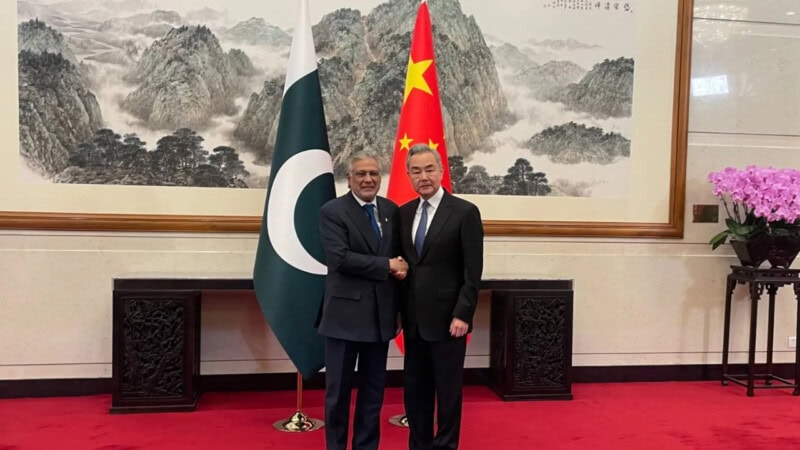
Pakistan and China have issued a five-point plan aimed at restoring peace and stability in the Middle East, calling for an immediate ceasefire and the start of negotiations amid the United States (US)-Israeli war on Iran.
The development came as Deputy Prime Minister (PM) and Foreign Minister (FM) Ishaq Dar undertook a one-day visit to Beijing at the invitation of Chinese Foreign Minister Wang Yi for discussions on regional developments, the Foreign Office (FO) said.
In a statement issued after the meeting, the FO said that both sides reviewed the situation in the Gulf and the Middle East and presented a five-point proposal. The two countries called for the “immediate cessation of hostilities and utmost efforts to prevent the conflict from spreading”, adding that humanitarian assistance must be allowed in all affected areas.
They also called for peace talks at the earliest. “Sovereignty, territorial integrity, national independence and security of Iran and the Gulf states should be safeguarded. Dialogue and diplomacy are the only viable options to resolve conflicts,” the statement read.
“China and Pakistan support the relevant parties in initiating talks, with all parties committing to a peaceful resolution of disputes, and refraining from the use or the threat of use of force during peace talks,” it added.
On the conduct of hostilities, both countries stressed the protection of civilians and non-military sites.
“China and Pakistan call on parties to the conflict to immediately stop attacks on civilians and nonmilitary targets, and fully adhere to International Humanitarian Law,” the statement said, also calling for an end to attacks on infrastructure, including energy, desalination and power facilities, as well as nuclear installations.
The two sides also highlighted the need to ensure maritime security.
“China and Pakistan call on the parties to protect the security of ships and crew members stranded in the Strait of Hormuz, allow the early and safe passage of civilian and commercial ships, and restore normal passage,” the statement said.
In a separate statement, the FO said that Dar and Wang reviewed bilateral relations and exchanged views on regional developments. As both countries mark 75 years of diplomatic ties, they reaffirmed commitment to strengthening cooperation, including under CPEC 2.0, and maintaining coordination at multilateral forums.
The statement said that Wang appreciated Pakistan’s diplomatic efforts, while both sides agreed to remain in close contact.
Chinese foreign ministry spokeswoman Mao Ning earlier said the two countries would “strengthen strategic communication and coordination on the Iran situation” and “make new efforts toward advocating for peace”.
Dar, in a post on X, said his discussions with Wang included “substantive, thoughtful, and forward-looking exchanges”.
Earlier, Wang had said that initiating peace talks in the war involving Iran “is no easy task” but noted such efforts would be “conducive to restoring normal navigation through the Strait of Hormuz”. He had also conveyed China’s support for Pakistan’s role as a mediator.
The FO said that this was Dar’s second visit to Beijing this year, adding that Pakistan and China maintain close coordination on regional and international issues.