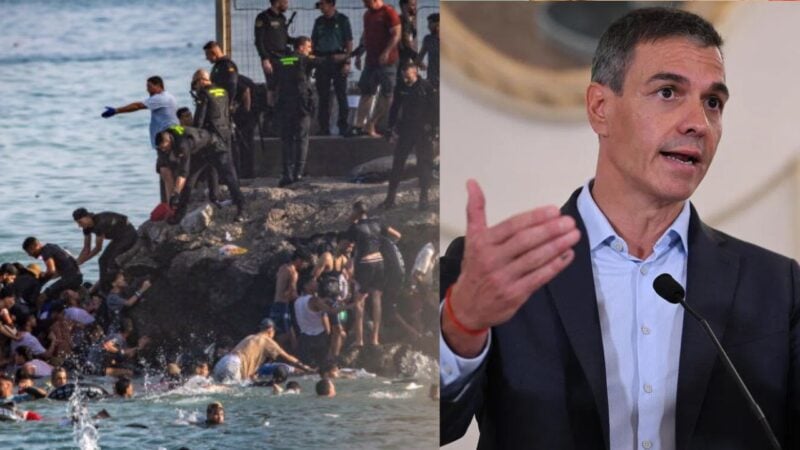
Spain Prime Minister (PM) Pedro Sánchez took to social media platform X to reject condemnation from European allies after tens of thousands of migrants crossed into Spain’s North African enclave of Ceuta, arguing that statistics show other member states face far higher irregular entry numbers.
Responding directly to calls from Italy and the Czech Republic to restrict Spain’s open-border access, Sánchez stated that European unity remains essential.
“Solidarity and empathy are optional. Respect for European treaties and data is not,” Sánchez posted on X.
“This is not the time to divide. It is the time to continue building a strong and united EU,” he added.
Sánchez cited official Frontex figures detailing irregular entries into Europe between 2021 and 2026. The data recorded 478,600 entries via Italy, 340,600 via the Western Balkans, 259,800 via Greece, 234,760 via Spain, and 48,000 via the eastern border.
The statement followed Italy’s decision to suspend Schengen border-free travel arrangements with Spain, reinstating checks on passenger flights.
Italian PM Giorgia Meloni called the events in Ceuta a security threat to Europe, while Czech Republic leader Andrej Babiš requested Spain’s temporary suspension from the Schengen area.
Finland’s Interior Minister Mari Rantanen claimed that Spain failed to secure its perimeter, and German Chancellor Friedrich Merz demanded Morocco take back individuals without delay. United Stated (US) President Donald Trump separately labeled the influx a product of weak law and bad management.
Spain’s foreign ministry summoned the Italian ambassador to Madrid on Friday, describing Meloni’s remarks as improper demagoguery.
The diplomatic spat stems from a sudden wave of crossings into Ceuta, where local officials reported nearly 60,000 arrivals equal to 70 percent of the territory’s 83,600 population. Spain’s Interior Ministry placed the figure at 50,000 since early Thursday. At least 57 people died during the attempt, according to spain’s local media.
Sánchez, who visited Ceuta on Friday, attributed the influx to criminal networks misinterpreting a recent Spanish Supreme Court ruling. The court determined that authorities cannot summarily return migrants intercepted at sea back to Morocco.
“What has emerged from our talks with Moroccan authorities is that trafficking mafias took a self-serving interpretation of a Supreme Court ruling which spread like wildfire,” Sánchez said.
Migrants bypassed border controls by swimming around coastal jetties or walking along shoreline rocks, entering the city wet and clad in swimwear. Officials estimate at least 7,000 of those who entered in a 24-hour window are minors.
Spain’s local authorities advised businesses to close as crowds filled public squares seeking food.
Spain deployed armed forces to bolster security in Ceuta and Melilla. Spanish officials confirmed that over 48,000 people have since walked back to Morocco voluntarily, with Moroccan authorities cooperating on processing returns.