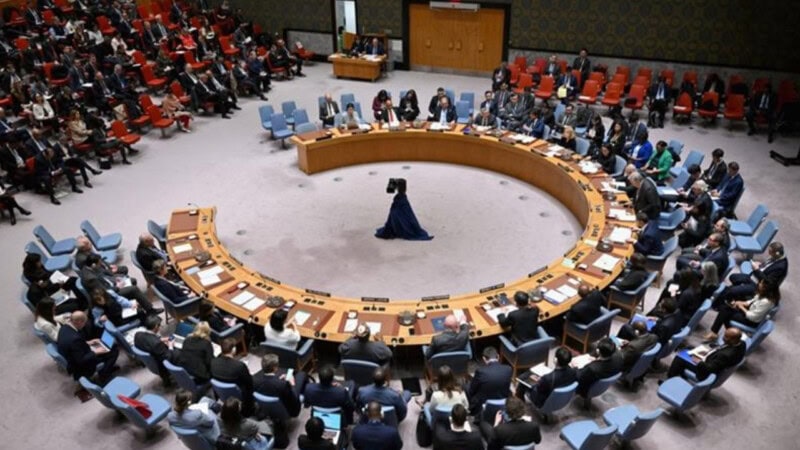
The United Nations (UN) Security Council remains divided over a resolution seeking to reopen the Strait of Hormuz, with delays in voting reflecting differences among members.
The draft, backed by Gulf states and the United States (US), has seen the vote pushed from Thursday to Saturday as Bahrain, the council’s current president, continues lobbying efforts.
Bahrain has introduced a fifth version of the resolution that would allow countries to use “all defensive means” to secure maritime transit through the strait. Earlier drafts included references to Chapter VII of the UN Charter, which authorises enforcement measures, however, it was removed after objections from China, Russia and France.
Disagreements persist over Operating Paragraph 2 (OP2), which calls for “using all defensive means necessary and commensurate with the circumstances” in the Strait of Hormuz and nearby waters.
Bahrain, with support from the UAE, has held bilateral meetings with all 15 council members, including Pakistan, focusing on persuading China and Russia not to use their veto.
The push for the resolution comes from the Gulf Cooperation Council (GCC), which includes Saudi Arabia, the UAE, Qatar, Kuwait, Oman and Bahrain. The bloc has moved collectively after the Strait, a key route for global oil and gas supplies, was closed off by Iran as a countermeasure to attacks on its territory.
The debate follows Iran’s closure of the waterway shortly after illegal US and Israeli strikes on February 28. The move disrupted energy markets, halted exports from Gulf producers and increased shipping and insurance costs.
Under the UN Charter, at least nine votes in favour and no veto from the five permanent members – United States, Russia, China, France and the United Kingdom – are required for the resolution to pass.
Russia and China have raised concerns linked to Iranian sovereignty, while France’s president has described calls to forcibly reopen the strait as “unrealistic” and “fraught with risk”.
Iran has warned against the measure, calling it a “provocative action”. Foreign Minister Abbas Araghchi said that such a move would “complicate the situation”.
For Gulf states, the closure has affected exports that pass through the narrow waterway. The situation has also affected engagement between GCC states and Iran, with recent diplomatic efforts giving way to a coordinated position within the bloc.
Analysts say the Bahrain-led draft serves both military and political purposes, noting that GCC states rely on US support to secure the strait while also placing the issue on the UN agenda.