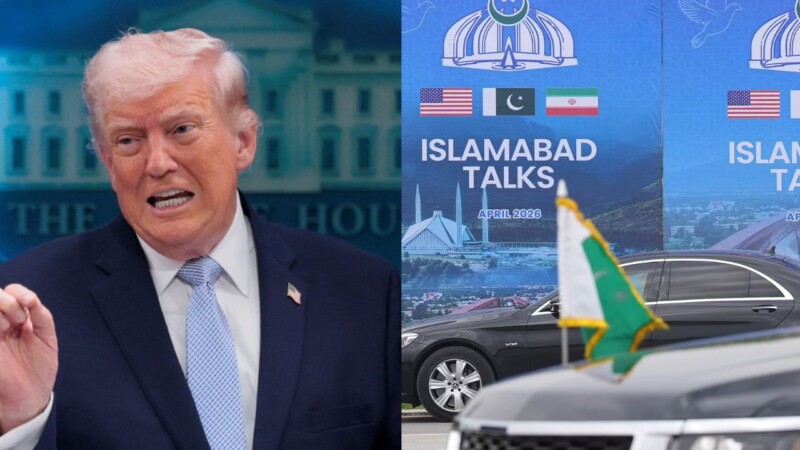
President Donald Trump of the United States has indicated that discussions between Washington DC and Tehran could resume within the next two days, with Pakistan emerging as the likely venue for the next phase of negotiations.
“You should stay there, really, because something could be happening over the next two days, and we’re more inclined to go there,” Trump told a journalist from an international media outlet on Tuesday.
He later contacted the outlet again half an hour after the initial conversation, reiterating that negotiators may return to Islamabad.
Trump pointed to Pakistan’s diplomatic efforts as the reason for considering the country. “It’s more likely that we go back there. Why should we go to some country that has nothing to do with it?” he stated, praising Chief of Defence Forces (CDF) Field Marshal Asim Munir’s efforts in leading mediation efforts.
“Because the Field Marshal is doing a great job. He’s fantastic, and therefore it’s more likely that we go back there,“ he told media outlet.
Earlier in the day, Trump had described the talks as “happening, but, you know, a little bit slow”, before suggesting that a second round might take place somewhere in Europe. His subsequent remarks shifted focus back to Islamabad.
Trump confirmed he would not participate directly in the negotiations.
The president’s comments followed reports that negotiating teams from both the US and Iran could return to Islamabad later in the week. Pakistan hosted direct Iran-US talks over the weekend, marking the highest engagement between the two countries since 1979.
Both delegations departed Islamabad on Sunday after the talks concluded without reaching an agreement, though without a breakdown either.
Pakistani officials had been in contact with both sides about timing for the next round. A senior government official noted that Islamabad received a positive response from Iran regarding willingness to participate in further talks.
Intermediaries, working with backing from Turkiye and Egypt, have been engaged in back-channel exchanges to bring the two sides back to the table, with the immediate priority being to extend the ceasefire.
Prime Minister (PM) Shehbaz Sharif told the federal cabinet on Monday that efforts were ongoing to resolve the conflict. He briefed President Asif Ali Zardari on upcoming visits to Saudi Arabia and Turkiye “for further engagement to promote peace efforts” and discussed details of the dialogue between Iran and the US.
The ceasefire, brokered on April 8 following weeks of conflict, is set to expire on April 22. The US has moved toward enforcing a naval blockade of Iranian ports, prompting Tehran to warn that such a step would violate the ceasefire agreement.
Pakistan has moved to consolidate international support since the talks ended. Deputy Prime Minister (DPM) and Foreign Minister (FM) Ishaq Dar held a series of calls with counterparts including Britain’s Yvette Cooper, China’s Wang Yi, Turkey’s Hakan Fidan, Saudi Arabia’s Prince Faisal bin Farhan, and Egypt’s Badr Abdelatty.
Across these engagements, Pakistan conveyed that all parties must uphold the ceasefire and that dialogue remains the only way forward. International partners responded positively to these messages.
Both sides have indicated willingness to continue negotiations. However, differences remain on the agenda, objectives, format, and venue for the next round. Iran has expressed preference for Islamabad, citing familiarity with Pakistan’s role as mediator. The US side has been considering other options.