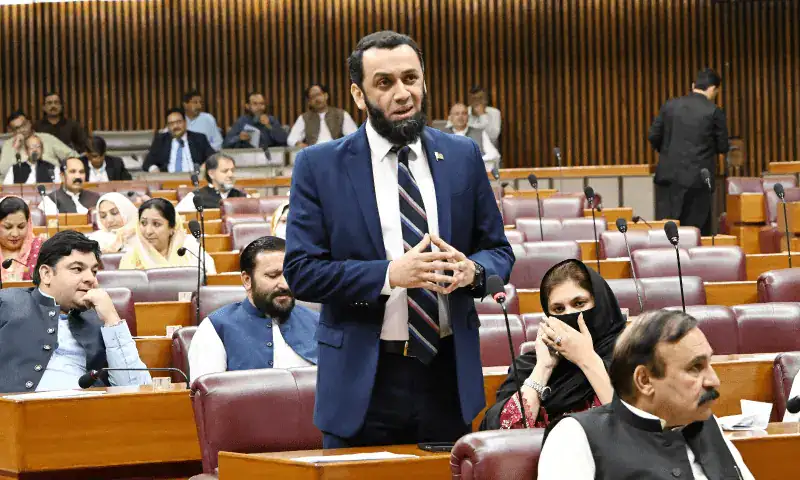
Federal Information Minister Attaullah Tarar has invited the opposition to sign a Charter of Economy (CoE) during a National Assembly (NA) session on Sunday. While defending the federal budget for the fiscal year 2026-27, Tarar credited the government’s economic policies for national progress.
He stated that the budget is relief-oriented for everyone, noting that Prime Minister Shehbaz Sharif approved a proposal to abolish the super tax. The minister highlighted an increase in national revenue and foreign remittances, asserting that “today the economy is on the right track”.
He also urged the opposition to acknowledge government decisions, specifically mentioning diplomatic efforts regarding peace in the Middle East.
The federal government presented the FY27 budget on June 12, introducing relief measures directed at the salaried, corporate, real estate, and export sectors to stimulate economic activity.
The financial plan focuses on enforcement measures instead of new taxes, though it introduces taxes on social media earnings alongside a fixed tax scheme for small traders and shopkeepers.
Responding to the information minister, Pakistan Tehreek-e-Insaf (PTI) leader Asad Qaiser stated that his party is willing to sign a Charter of Democracy to ensure the independence of the judiciary and the Election Commission of Pakistan.
Qaiser accused Tarar of misrepresenting facts and addressed a communication sent to the International Monetary Fund (IMF). “Has he read the letter that PTI wrote to the IMF? We have not written anything against Pakistan,” Qaiser stated.
The general debate on the federal budget began on Saturday, with lawmakers focusing heavily on political and regional issues. During the opening session, Opposition Leader Mehmood Khan Achakzai criticized the government for freezing development allocations for provinces.
During his address, Qaiser claimed that all budgetary proposals originated from the IMF. He stated that farmers in Punjab would face losses worth Rs2.2 trillion due to a lack of relief for the agricultural sector.
Qaiser also reported that 90 companies stopped their investments and exited Pakistan. Addressing regional grievances, Qaiser stated that tobacco farmers in Khyber Pakhtunkhwa (KP) faced a 390 percent tax increase. “You have made a monopoly of two cigarette firms,” Qaiser said.
He noted that the federal government owes KP Rs434 billion in outstanding dues, while the province has now been asked to pay Rs175 billion in taxes to the Centre.
Furthermore, Qaiser mentioned that trade with Afghanistan remained closed for the past year, leading to a loss in exports. He warned that rising unemployment in KP could drive youth towards militant groups.
PTI lawmaker Amir Dogar described the budget as the fifth financial plan presented by the ruling coalition partners, pointing to high inflation levels since the removal of the PTI government. “Rs4,365bn in petroleum levy was imposed on the people during last three months,” Dogar claimed.
Dogar designated the budget as anti-people, describing the Rs103 billion funding allocation for new dams as insufficient.
He asserted that the budget lacks relief for investors and fails to include measures to develop the agricultural sector. Dogar also used his floor time to demand the creation of a South Punjab province.