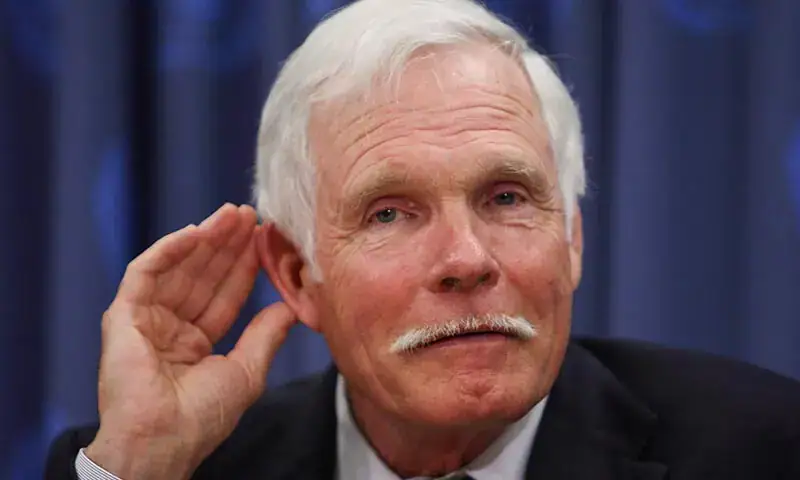
Ted Turner, founder of CNN and the media executive who changed the global news landscape by launching the first 24-hour news network, has died at 87. CNN announced the death of its founder on Wednesday, marking the end of an era.
Turner established the Cable News Network (CNN) in 1980, which began as news around the clock and at the time, the concept of a non-stop news cycle was met with industry skepticism.
Critics referred to the fledgling channel as the “Chicken Noodle Network,” predicting it would not succeed.
However, the network gained international prominence through its immediate coverage of major events, including the 1981 assassination attempt on Ronald Reagan and the 1986 Challenger shuttle explosion.
The network’s reporting during the 1990-1991 Gulf War solidified its position as a primary source for global intelligence. Former US President George H.W. Bush once remarked that he frequently learned more from CNN than from the CIA.
Current CNN CEO and chairman Mark Thompson called Turner “the giant on whose shoulders we stand,” describing him as an intrepid leader who trusted his own judgment. “He was and always will be the presiding spirit of CNN,” Thompson said in a statement.
Beyond journalism, Turner was a multifaceted figure. He took over his family’s billboard company following his father’s suicide and expanded it into the Turner Broadcasting System (TBS).
His portfolio eventually included TNT, Turner Classic Movies, and Cartoon Network. Known for a brash persona that earned him the nickname “the Mouth of the South,” Turner was also a world-class yachtsman who won the ‘America’s Cup’ in 1977.
In his later years, he turned heavily toward philanthropy, famously pledging $1 billion to the United Nations (UN) and supporting environmental causes.
“Ted Turner created an unstoppable media revolution for the benefit of all humankind,” wrote long-serving CNN correspondent Christiane Amanpour.
Turner, who was married to actress Jane Fonda for a decade, revealed in 2018 that he was living with Lewy body dementia.
Despite the loss of his media influence following a merger with Time Warner that impacted his fortune, his colleagues maintain that his legacy remains central to modern communication.
Former CNN boss Walter Isaacson described him as “the most fearless journalist” who remained undaunted by political or corporate pressure.