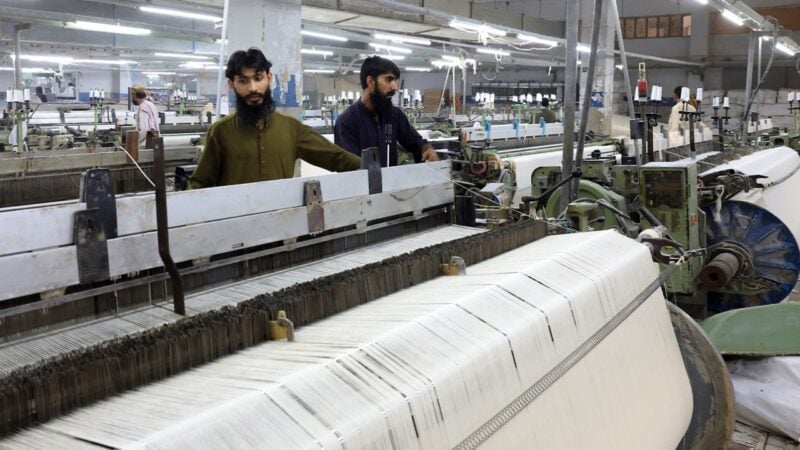
Pakistan’s textile and apparel exports rose 0.3 percent to around Rs499,050 crore in financial year 2025-26, their highest level in four years, despite a 5.9 percent decline in overall national exports, according to the Pakistan Textile Council’s first annual export performance report.
Total exports fell to around Rs835,632 crore, with textiles accounting for about 60 percent of the total, the report said.
The growth in textile exports came from apparel and home textile made-ups. Exports under Chapters 61 to 63 rose 1.1 percent to around Rs415,321 crore, increasing their share of textile exports to 83.2 percent from 77 percent in 2021-22.
Raw materials and intermediate products fell 3.4 percent to around Rs84,007 crore, a five-year low.
Non-knit apparel exports rose 3.9 percent to a record Rs119,079 crore, including a 19 percent increase in men’s cotton trousers and a 54 percent rise in women’s cotton trousers.
Home textiles and made-ups remained the largest single export chapter at around Rs158,171 crore, up 0.6 percent, while knitwear exports fell 0.7 percent to around Rs138,043 crore.
The European Union remained the largest market at around Rs196,931 crore, down from Rs200,951 crore.
Exports to the United States reached around Rs134,549 crore, while those to the UK stood at Rs47,964 crore.
Exports to China rose to around Rs17,855 crore, while those to Bangladesh remained broadly stable at around Rs17,190 crore, with both markets recording growth mainly in cotton yarn and fabric.
Pakistan Textile Council CEO Muhammad Hassan Shafqat said the modest increase demonstrated the sector’s ability to maintain global competitiveness, but warned of concerns over raw materials, particularly cotton.
He said cotton production fell to 5.5 million bales in the latest season, a three-decade low, compared with 14.8 million bales in 2011-12. The gap was increasingly being filled through imports, he said.
Textile and apparel exports fell 17 percent year-on-year and 23 percent month-on-month to around Rs35,211 crore in June 2026, indicating weaker order flows at the start of 2026-27.
The council proposed 11 measures across six areas, including lower corporate tax, faster refunds, competitive energy prices, improved financing, easier SME credit, stronger trade arrangements and a national cotton strategy.