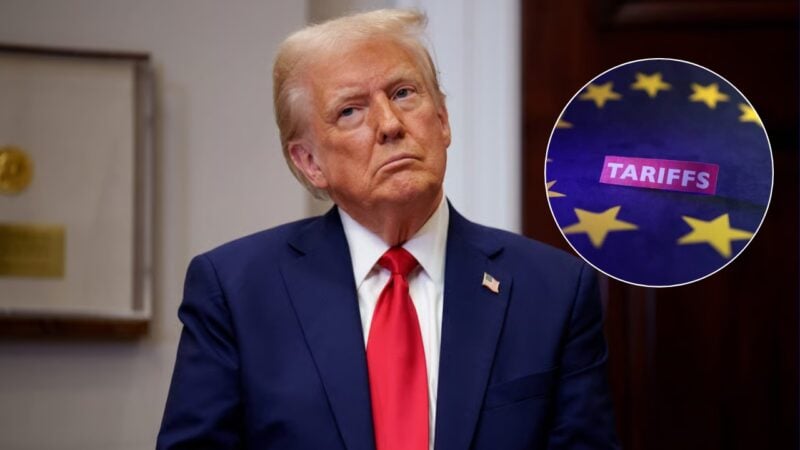
US President Donald Trump on Friday threatened to impose tariffs on the European Union and launch a formal trade investigation after Brussels fined Google €890 million ($1 billion) under the bloc’s digital competition rules.
In a post on his Truth Social platform, Trump said that the European Union “will pay a very big price for this illegal and highly unethical conduct, which I have consistently warned them about.”
He wrote that the United States would “immediately initiate a 301 Investigation” into what he described as the EU’s practice of “ROBBING” American companies and signalled a “substantial TARIFF” on the bloc “at the earliest possible moment.”
“The United States of America is not a ‘PIGGYBANK’ for Europe, nor will we allow it to be,” Trump wrote.
Section 301 of the US Trade Act of 1974 allows Washington to investigate foreign trade practices it considers discriminatory or unfair and, where justified, respond with measures including tariffs.
Trump’s remarks came a day after the European Commission imposed an €890 million ($1 billion) fine on Google for breaching the Digital Markets Act (DMA), the European Union’s landmark legislation regulating the conduct of dominant online platforms. It was the first penalty issued against the company under the law.
According to the European Commission, the decision comprised two separate fines. Google was fined €460 million for giving preferential treatment to its own shopping, hotel, transport and sports services in search results.
A further €430 million penalty was imposed over restrictions that prevented app developers from directing users to lower-priced offers outside the Google Play Store.
US Trade Representative Jamieson Greer criticised the Commission’s decision on Thursday, saying that the EU’s enforcement action undermined “constructive dialogue” and posed a “real risk” to transatlantic trade stability.
The dispute also puts pressure on the trade framework agreed between Washington DC and Brussels last year, which reduced US duties on European cars in exchange for concessions from the European Union.
European Union officials have repeatedly maintained that the bloc’s digital regulatory framework is not designed to target American technology companies.