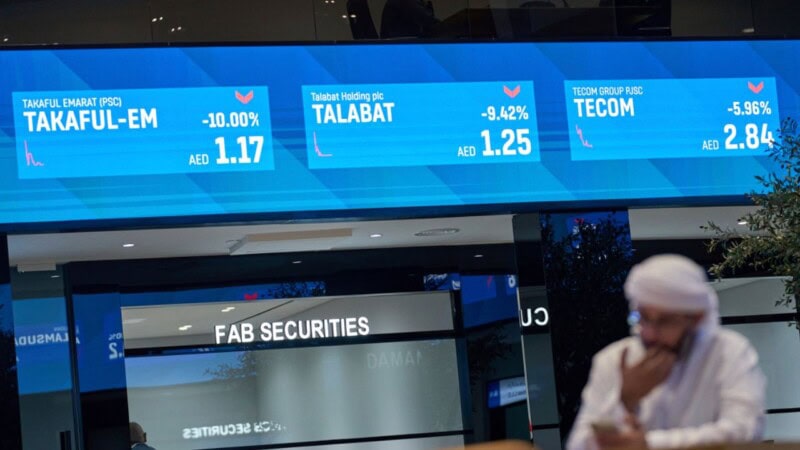
Stock markets in the United Arab Emirates (UAE) have shed nearly $120 billion in value since the United States (US) and Israel launched their war on Iran on February 28, placing Dubai and Abu Dhabi among the worst-performing markets during the period.
Dubai’s benchmark index has fallen around 16 percent, while Abu Dhabi’s has declined about nine percent.
The Dubai Financial Market (DFM) General Index has lost close to $45 billion in market capitalisation, while the Abu Dhabi Securities Exchange (ADX) General Index has shed about $75 billion.
Across the Gulf, markets have moved unevenly. Qatar’s exchange is down about four percent and Bahrain’s around seven percent, while Saudi Arabia and Oman have recorded gains.
On Wall Street, the S&P (Standard & Poor’s) 500 has dropped roughly seven percent over the same period, amid statements from US President Donald Trump regarding the timeline and objectives of the war.
Despite lower exposure to the energy disruptions caused by Iran’s closure of the Strait of Hormuz, the conflict has affected the UAE’s travel sector.
Flight operations have been disrupted, with tens of thousands of cancellations reported, including routes linked to Dubai International Airport, the busiest for international passengers.
Tourism and travel contributed about $70 billion to the UAE economy last year, accounting for 13 percent of GDP, according to state media.
Haytham Aoun, assistant professor of finance at the American University in Dubai, stated that the decline should be seen as a “temporary shock”.
“It is clearly a short-term setback to investor sentiment and market confidence, but not necessarily a fundamental challenge to the UAE’s long-term economic plan,” he told an international media outlet.
“International financial centres are judged not only by market performance during crises but also by the quality of regulation, liquidity management, institutional resilience, and operational continuity.”
The UAE has expanded its financial sector as part of its economic diversification strategy and ranks among the leading capital markets in the region.
The total value of UAE-listed stocks crossed $1 trillion in 2024, second to Saudi Arabia’s $2.5 trillion market in the Middle East.
Under a 10-year economic plan announced in 2023, authorities have set a target for Dubai to rank among the top four global financial centres by 2033.