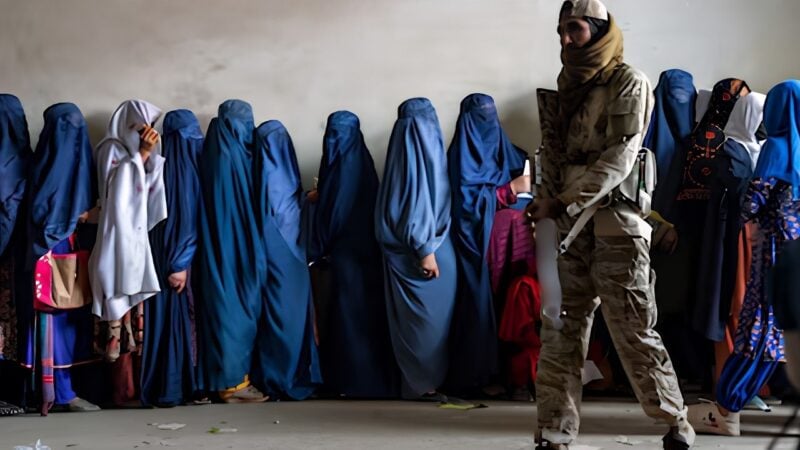
The United Nations (UN) has expressed concern over reports of the arrest of several women by the Afghan Taliban’s morality police in a crackdown on clothing in the western city of Herat.
The United Nations Assistance Mission in Afghanistan (UNAMA) said that it was concerned over the arrests of women for alleged non-compliance with dress requirements after media reports said that at least 21 women and young girls had been detained.
The UNAMA urged Taliban authorities to remind themselves that all people have the right to freedom of movement and that both women and men were entitled to equality before the law.
Residents who spoke to AFP on condition of anonymity described scenes of Taliban officials stopping vehicles and pulling women out for not wearing the body-covering burqa.
A 23-year-old woman said that she witnessed two officials from the Ministry for the Propagation of Virtue and the Prevention of Vice (PVPV), one carrying a whip, forcing two women into a vehicle. She noted that those detained were fully covered, including wearing headscarves. “Everyone is frightened,” she told AFP.
A 27-year-old woman said that she saw officials checking passengers in multiple vehicles and detaining women who were not wearing chaddars.
The PVPV ministry, when contacted, said that there was “nothing unusual in Herat” and described the dress code as “a divine command and an enforced law”.
Since the crackdown began, an AFP journalist and multiple residents said that the number of women venturing outside had dropped sharply. A 20-year-old taxi driver said that women were “not seen in the city at all”, adding that drivers had been told not to transport women without a chaddar.
One woman described the situation as “unbearable”. “I am genuinely saddened that we don’t even have the right to breathe freely,” the 33-year-old said. “Life has become very difficult for us”.
Taliban authorities have steadily tightened restrictions on women since returning to power in August 2021, requiring women to be completely covered when leaving home.
A UNICEF report from April warned that Afghanistan could lose more than 25,000 female teachers and health workers by 2030 if restrictions on girls’ education and women’s employment remain in place.