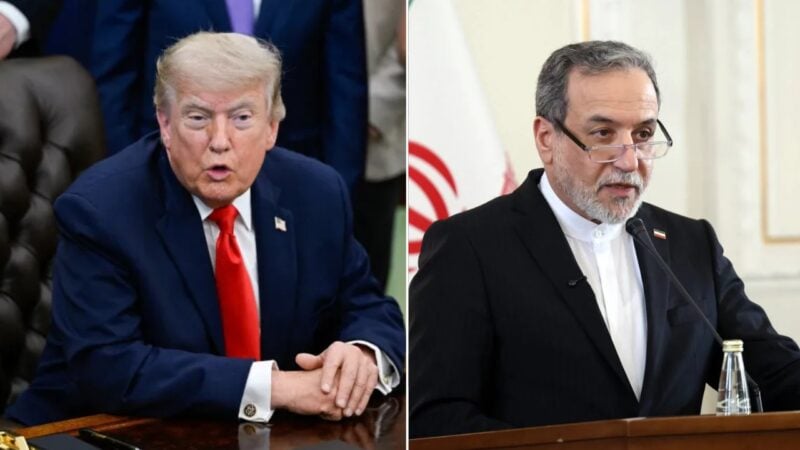
The United States (US) and Iran have reached a regional peace agreement, prompting an immediate order to lift naval blockades and restore trade routes. “This Great Deal will bring Peace and Security to the whole Region,” US President Donald Trump stated, adding that “with the opening of the Strait upon the signing of the Deal on Friday, for purposes of mine removal, oil will flow on both ends again for the Region and the World!”
Trump announced the lifting of the naval blockade on Truth Social, stating, “I hereby fully authorize the toll free opening of the Strait of Hormuz, and, simultaneously herewith, authorise the immediate removal of the United States Naval blockade,” before adding, “Ships of the World, start your engines. Let the oil flow!”
He told the New York Times (NYT) the agreement would ensure the waterway is “permanently toll free” and argued that he had saved Israel from nuclear obliteration. Trump warned that if a final accord is not reached, he would restart military attacks or make the US the guardian of the Middle East for “20 per cent of the region’s revenues”.
A senior Iranian official told Reuters that the draft covers Iran’s nuclear limits, the opening of the Strait of Hormuz and US waivers on oil sanctions.
Iranian media via Mehr news agency reported a 14-point document stipulating “The release of 24 billion dollars in frozen Iranian assets during the 60-day negotiation period,” specifying that “half of this amount must be made available to Iran before the start of the negotiations”.
Under the terms, Tehran will not produce or acquire nuclear weapons and will freeze its uranium enrichment.
Iranian President Masoud Pezeshkian stated that “The Supreme National Security Council has concluded that the path of dialogue should be pursued,” adding that Tehran enjoys “very good relations” with neighbours and misunderstandings are “on the path to resolution”.
Iranian Foreign Minister (FM) Abbas Araghchi stated that “regional security cannot be shaped through eliminating or ignoring Iran,” adding that sustainable stability requires “collective cooperation”.
Prime Minister (PM) Shehbaz Sharif announced that a peace agreement between the United States (US) and Iran has been reached. “Both sides have declared the immediate and permanent termination of military operations on all fronts, including in Lebanon,” he stated in a post on X, adding that “the official signing ceremony will be on Friday, 19 June in Switzerland”.
Shehbaz thanked the US, Iran, Qatar, Saudi Arabia and Turkiye for their roles, stating that “these pre-implementation discussions will lay the foundation for the technical talks and the official signing ceremony”.
The developments occurred as Lebanese civil defence recovered three bodies and recorded 15 wounded after an Israeli strike on the Ghobeiry area in Beirut’s southern suburb of Dahiyeh.
Following the strike, Iranian state media reported that “flights from airports in the western part of the country have been cancelled until further notice”.
Trump told Axios the strike delayed the signing, stating, “It shook it up. It delayed the signing by a few hours. It was supposed to be now. Now it is scheduled for a few hours from now”.
Trump fumed at Israeli Prime Minister Benjamin Netanyahu, stating, “It is so bad I couldn’t believe it. An hour before we are supposed to sign the deal”. Trump told Fox News he will ask Iran not to retaliate, posting on social media that “this could be the beginning of a long and beautiful peace. Let’s not blow it!”
Inside Iran, officials threatened retaliation. Ebrahim Azizi, head of the parliament’s national security committee, stated that “a strong response is coming,” adding that the strike “once again proved the US is weak without credibility, as it is not even capable of controlling this illegitimate regime”.
Parliament Speaker Mohammad Bagher Ghalibaf stated that “the Zionists’ incursion into Dahiyeh has once again shown that America either lacks the will to fulfil its commitments or the ability to do so,” calling the US-Israel “good cop, bad cop” routine “outdated”. He added that “if you lack the will and ability to fulfil your commitments, speaking of continuing the path is not possible”.
Iranian military commander Ali Abdullahi stated that the military has a “finger on the trigger”, ready to shoot at the “enemy’s heart”.
Sardar Asadi of the Khatam al-Anbiya headquarters stated that “without a doubt, these crimes will not go unanswered”. Fars news agency reported Iran was conveying “desired clauses” to the US through Qatar before the strikes.
Meanwhile, the Egyptian presidency announced President Abdel Fattah al-Sisi will hold a bilateral meeting with Trump at the G7 summit to discuss “the ways to resolve international geopolitical crises and address their repercussions on trade, energy and supply chains”.