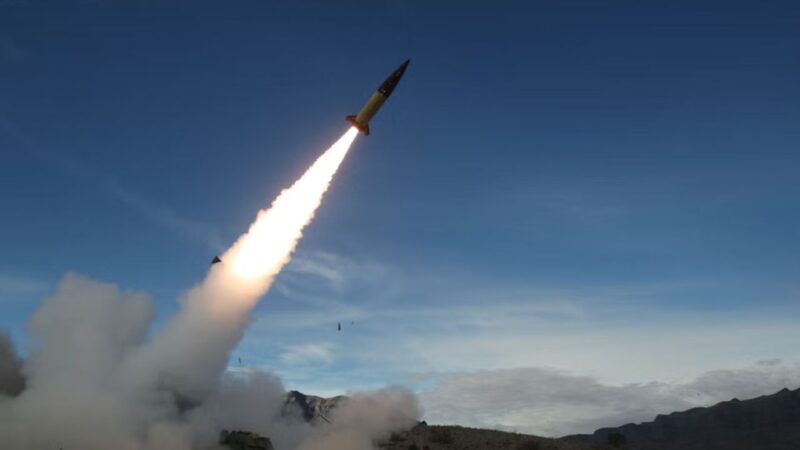
The United States (US) has reportedly used up “virtually all” of its stockpile of Army Tactical Missile Systems (ATACMS) and Precision Strike Missiles (PrSM) after five months of war with Iran, according to two sources who spoke to an international media outlet.
The two systems, known as ATACMS and PrSM, form the army’s surface-to-surface missile arsenal and are prized for their accuracy. Sources declined to specify exact remaining numbers, but the depletion follows a warning issued last month by an official that the US military lacked sufficient stock for a return to full-scale conflict.
President Donald Trump has threatened Iran with major strikes on several occasions, only to pull back at the last minute each time. The missiles in question, priced above $1 million apiece, allow forces to hit targets accurately from a safe distance and ATACMS supplied to Ukraine have similarly enabled strikes deep inside Russian territory. PrSM represents a newer generation intended to eventually replace the shorter-range ATACMS altogether.
With ground-launched stockpiles running low, the Pentagon would need to lean more heavily on piloted bombing runs should Trump proceed with a renewed large-scale offensive against Iran, a riskier method of attack than missile strikes.
Trump had launched the war jointly with Israel in February, predicting a swift conclusion, but as the conflict has extended, three people familiar with the matter said that the declining missile supply could weaken America’s ability to deter other potential adversaries, including Russia and China, in potential future attacks.
A fourth source said that while Central Command (CENTCOM), which oversees US forces across the Middle East, had nearly exhausted the land-based missiles it held before the war began, it managed to draw additional supplies from American military stocks positioned elsewhere in the world.
Responding to questions about stockpiles, the White House said that the US possessed “far more munitions than anyone in the world” and “far more than we need.” Trump added that American defence companies were manufacturing munitions at record volumes while simultaneously expanding their production plants and equipment.
Analysts broadly agree that output of certain munitions, including artillery shells and specific missile types, has reached record levels, though they caution that current supplies may not be enough to sustain a prolonged war.
Lockheed Martin, which manufactures the ATACMS, PrSM and the THAAD anti-ballistic missile system, did not respond to questions regarding the stockpile levels or Trump’s remarks.
Raytheon, maker of Tomahawk missiles and Patriot interceptors, also did not respond. Pentagon chief spokesman Sean Parnell said, “America’s military is the most powerful in the world and has everything it needs to execute at the time and place of the president’s choosing.”
He added, “We have executed multiple successful operations across combatant commands while ensuring the US military possesses a deep arsenal of capabilities to protect our people and our interests.”
The supply figures have been circulating within the federal government over the past week, coinciding with tense internal discussions in the Trump administration about how much longer strikes on Iran can continue before the stockpile falls to levels that would limit the military’s capacity to respond to crises elsewhere.
One source said that the drawdown of ATACMS and PrSM reflected a deliberate decision by the administration to avoid riskier means of striking Iranian targets, such as piloted bombing missions.
Analysts noted that because these missiles allow strikes from a distance, they would carry particular value in any future conflict against an adversary with strong air defences, such as China. A March report by the Centre for Strategic and International Studies confirmed that the missiles have already been used to strike targets inside Iran.
The same report noted that PrSM stockpiles were limited from the outset given the munition’s relatively recent introduction, though the US military has placed large orders for delivery in 2027.
The Army has said that ATACMS are being phased out as production shifts toward the newer PrSM. Two sources said that military leaders have for weeks cautioned the president that stocks of defensive weapons, including Patriot interceptors effective against ballistic missiles, were also declining.