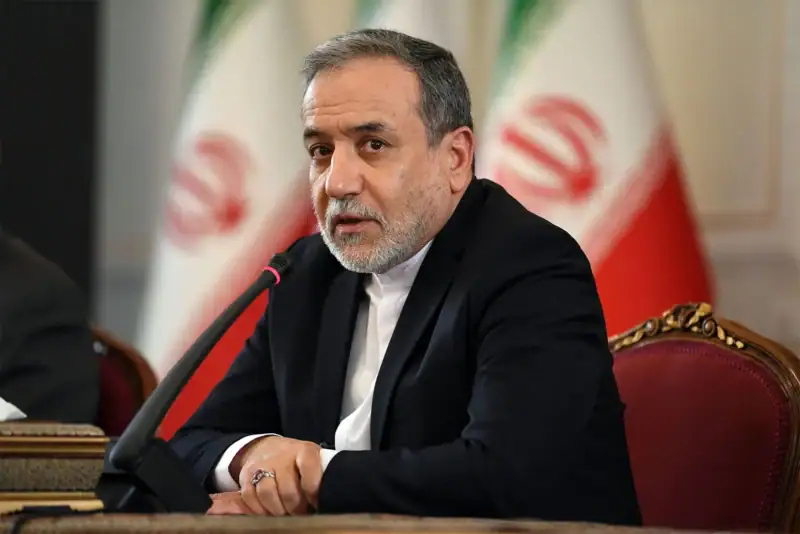
The Iranian Foreign Minister has said that the United States (US) made “two miscalculations” by initiating military actions without accounting for the regional resistance front.
Speaking to the IRNA news agency, Abbas Araghchi stated that “they started the war, they didn’t account for the resistance.” He explained that Iran will end the conflict with the US only when it has “the upper hand in the field,” adding that the end of the war is possible either through absolute military victory or through negotiations.
“The right time to negotiate is precisely when you have achieved a reliable field and strategic achievement on the military front,” Araghchi stated, adding that decisions must rely on “accurate and complete calculations” because “you cannot take risks with the lives of the people and the fate of the entire country.”
The statement comes amid widespread military escalations across the Middle East. The United States Central Command (CENTCOM) confirmed the completion of its ninth consecutive evening of strikes against Iran.
CENTCOM assets targeted command centers, air defence, coastal surveillance sites, maritime capabilities, missile and drone launch sites and communications networks.
CENTCOM stated that the actions aimed to “further diminish Iran’s ability to attack commercial vessels and civilian mariners transiting the Strait of Hormuz,” adding that “the US military is holding Iran accountable at the commander in chief’s direction.”
US President Donald Trump addressed the military operations upon his return to Washington DC after the final of the FIFA World Cup 2026, stating that the US is hitting Iran “very hard” to honour American service members killed in action.
“We hit them very hard again tonight, and we did that in honour of the, probably three, it’s probably three great patriots,” Trump told reporters, adding that those who died were fighting so that “Iran cannot have a nuclear weapon.”
In response, Iran’s Islamic Revolutionary Guard Corps (IRGC) claimed responsibility for multiple attacks on US military facilities across the region. The IRGC announced it targeted the Ali Al Salem airbase in Kuwait, claiming a drone attack destroyed an early-warning radar system, an aviation equipment warehouse, and a hangar housing US MQ-9 drones.
Separately, a missile strike caused a massive fire at a Kuwaiti power plant. The Kuwaiti army confirmed it responded to Iranian drone attacks, noting that loud sounds heard across the country resulted from interceptions.
The IRGC also claimed it launched ballistic missiles at US C-17 transport planes and P-8 aircraft at Aqaba airport in Jordan, causing heavy damage to the aircraft and destroying 20 hangars housing US forces at the Muwaffaq Salti/Al-Azraq air base.
IRGC Brigadier-General Yadollah Javani issued a statement on Telegram stating the IRGC has delivered “heavy blows to American bases in Jordan, Kuwait, Oman and other nations and this seriousness will continue.”
Javani stated that, “The Americans are trying to compensate for their defeat in this war through military actions and return the Strait of Hormuz to its pre-war conditions, but they will certainly not succeed.” The commander also vowed “revenge and retribution” for the killing of Supreme Leader Ali Khamenei.
In Iran, state media reported strikes inside the country. Mehr news agency reported the governor of Bushehr stated several locations in the city were hit in an attack, with the scope and extent currently under investigation.
The IRGC claimed further defense successes, stating it shot down a US spy drone conducting surveillance in southern Iran, an MQ-9 drone in the sky of Ahvaz, and intercepted a US cruise missile in western Iran.
The Iranian military also stated its navy air defence systems shot down an American Lucas (Low-cost Uncrewed Combat Attack System) drone in southern Iran.
Amid escalating military actions, US Secretary of State Marco Rubio claimed that Iran is using the Strait of Hormuz as leverage and called on international partners to help safeguard the maritime corridor.
Speaking to reporters before traveling to the Philippines, Rubio stated the US would continue steps to protect maritime traffic but argued other governments must contribute equipment or funding to share the burden.
The disruptions to energy shipments through the Strait of Hormuz caused oil prices to advance by over 3 percent in early Asian trading. Brent crude futures increased by $2.75, or 3.12 percent, to reach $90.85 a barrel. Concurrently, US West Texas Intermediate (WTI) crude futures rose by $2.56, or 3.10 percent, to settle at $85.05 a barrel.





