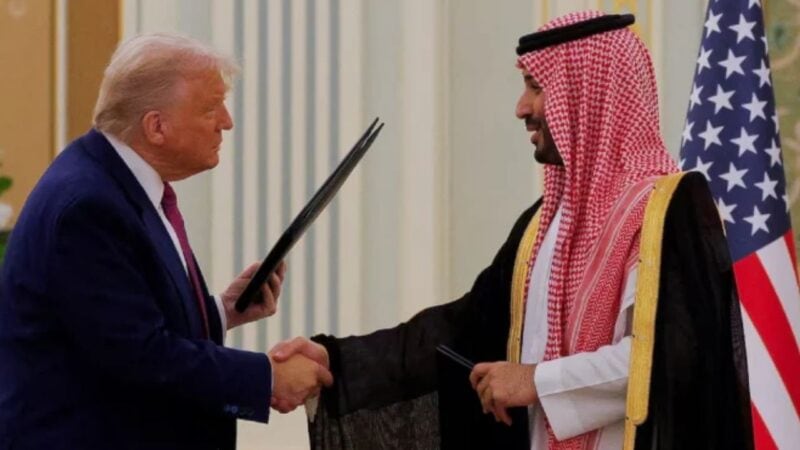
The United States (US) is set to announce an agreement with Saudi Arabia on Wednesday, granting the kingdom a civilian nuclear programme, media reports said, as fighting resumes between the Gulf state and Houthi rebels in Yemen.
Two unnamed US officials told an international media outlet that the Trump administration plans to formally sign and unveil the deal on Wednesday. The administration has stated the agreement will bring billions of dollars into the US nuclear industry.
Under one provision, the 30-year deal would allow American companies to build a uranium enrichment facility in Saudi Arabia, provided a joint study finds it justified, the Wall Street Journal (WSJ) reported.
The agreement is expected to reach Congress within days, though lawmaker approval is not a requirement for it to take effect. Two sources told an international media outlet that a document known as a 123 Agreement will be submitted to lawmakers, to be signed by US Energy Secretary Chris Wright and Saudi energy minister Abdulaziz bin Salman. The two had already signed a preliminary version of the agreement in Riyadh last year.
The 123 Agreement draws its name from Section 123 of the US Atomic Energy Act of 1954, which is required before the US government and American firms can partner with Saudi entities to build a multibillion-dollar civil nuclear industry.
Sources familiar with the agreement noted that it excludes the “Gold Standard” provision, which would have barred the kingdom from enriching uranium and reprocessing spent fuel, both considered potential routes to nuclear weapons. The same sources added that the deal also leaves out the “Additional Protocol”, which grants the International Atomic Energy Agency (IAEA) wider powers, including snap inspections at undeclared sites.
Accounts differed on timing. One source said that the submission could come as soon as Wednesday, while another put it at around a week away. A third source, who did not comment on whether the agreement lacks safeguards, said only that it would be submitted soon.
Wright had previously said that the preliminary agreement was not about enrichment and that it carried all the nonproliferation standards found in the Atomic Energy Act, calling them among the strongest in the world.
One source explained that the agreement opens a legal pathway for cooperation on the nuclear fuel cycle, including enrichment, without obligating Washington to hand over any related capability or technology.
Concerns over proliferation trace back to Crown Prince Mohammed bin Salman, who has long maintained that Saudi Arabia would pursue a nuclear weapon if Iran developed one, a position that has worried arms control advocates and several US lawmakers.
Speaking to CBS in 2018, the crown prince said, “Saudi Arabia does not want to acquire any nuclear bomb, but without a doubt if Iran developed a nuclear bomb, we will follow suit as soon as possible.” The kingdom has also insisted on retaining the right to enrich uranium.
By comparison, the United Arab Emirates (UAE) accepted the Gold Standard in 2009 when it signed its own 123 Agreement with Washington.
Once submitted, 123 Agreements enter a review period of roughly 90 continuous congressional session days during which lawmakers can object, after which they take effect automatically.
Blocking the agreement would require Congress to pass a joint resolution backed by a two-thirds majority capable of overriding a presidential veto.
Several Democrats and some Republicans, including Secretary of State Marco Rubio during his time in the Senate, have pushed for any such agreement to include stronger guardrails.





