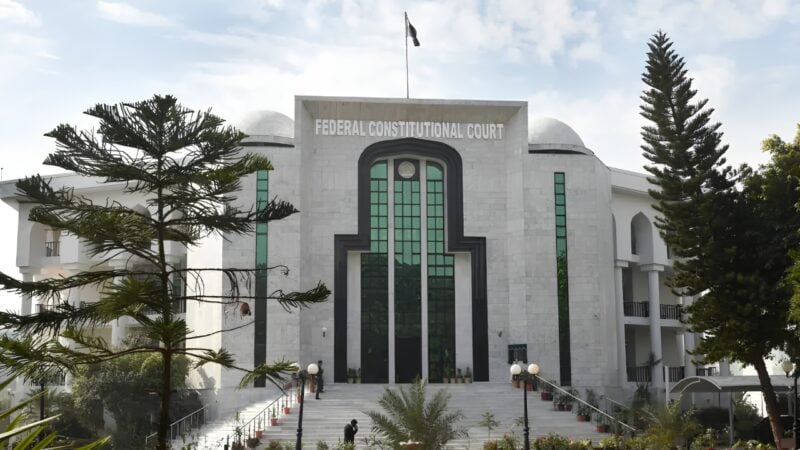
The Federal Constitutional Court (FCC) has ruled that workplace misconduct does not fall within the jurisdiction of the ombudsperson under the Protection against Harassment of Women at the Workplace Act, 2010 unless it has a sexual element.
The three-member bench, headed by Chief Justice Amin-ud-Din Khan, ruled that the term “harassment” may be used broadly to describe objectionable workplace conduct, but Section 2(h) of the law sets a narrower threshold for cases that can be brought before the ombudsperson.
Justice Ali Baqar Najafi authored the judgment.
The ruling departs from a 2025 Supreme Court interpretation, which recognised gender-based discrimination and a hostile work environment as forms of workplace harassment.
The Supreme Court (SC) had also observed that harassment could result from the exercise of power and domination, rather than being driven by sexual desire.
The FCC said the statutory definition must determine the jurisdiction of the ombudsperson.
It held that conduct must have a sexual character to qualify as actionable harassment under the 2010 law.
The court acknowledged that misconduct by one employee towards another employee or an employer could be serious and carry other consequences.
Such behaviour, however, would not automatically become actionable under the Harassment Act without evidence of a sexual element.
“Undoubtedly, the Harassment Act, 2010, was legislated to protect not only working women but also working men but only against harassment having a sexual dimension at the workplace,” the judgment said.
The bench stated that behaviour could be offensive or have harmful consequences without becoming cognizable by the ombudsperson under the Act.
In such cases, the court noted, departmental disciplinary proceedings could apply.
The FCC also drew a distinction between gender-based sexual discrimination and ordinary misconduct.
It held that discriminatory treatment resulting from a prejudicial mindset based on gender could come within the law where the relevant sexual element was present.