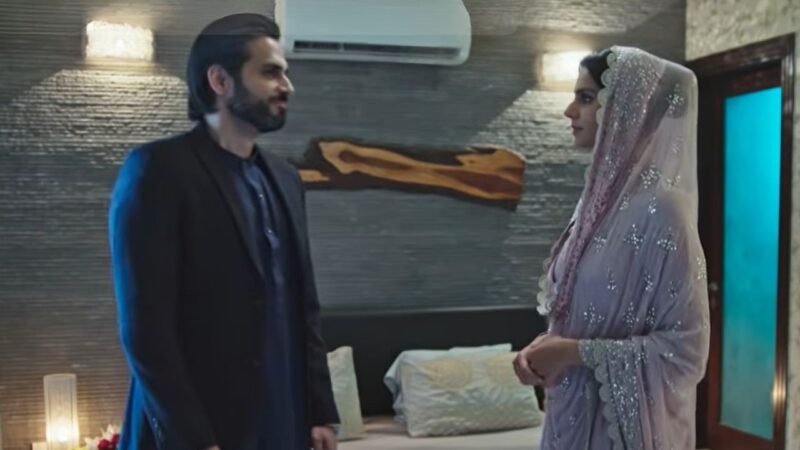
The final episode of the ARY drama ‘Kafeel’, starring Sanam Saeed and Emmad Irfani, sparked debate online as viewers remained divided over Zeba’s (Sanam Saeed) ending and whether her story should have concluded with remarriage or independence.
Written by Umera Ahmed, the drama followed Zeba, a woman trapped in a long, emotionally exhausting marriage with Jamshed aka Jami (Emmad Irfani), a financially unstable and emotionally abusive husband whose behaviour shaped much of her adult life. Set in the 1990s, the story explored marriage, divorce, emotional abuse, and the social pressure women face when choosing to leave unhappy relationships.
Zeba spent 24 years in a marriage that was never hers to begin with. She was pushed into it by a mother who trusted the wrong woman, married off to a man she thought was someone else, and then left to carry everything the bills, the children, the silence, and the weight of a husband who gaslit her for his own failures. Jamshed did not just fail as a partner. He made sure Zeba believed she was the reason he failed.
And yet, when the drama ended, she walked into another marriage.
The first thing worth asking is this: Zeba’s father stood by her. In the 1990s. When she wanted to leave. Her brother backed that decision too. The only person who resisted was her mother, who rushed Zeba into a marriage in the first place after misreading a moment with a man named Jamaal.
Zeba had a support system that most women in that era don’t. So why did she go back? She went back because she was pregnant, and the world outside felt impossible. That is not weakness. That is survival. But it does raise a question the drama never quite sat with long enough.
She stayed for 24 years. Not because she had no choice, but because she kept believing he would change. “Badal jaye ga” is not just a line in the show, it is a sentence millions of women in this country have repeated to themselves like a prayer. Jamshed never changed. He shouted, he accused, he cheated, and when none of that broke Zeba completely, he hit her. That was the line. Not the years of accusations. Not the emotional abuse. Not the gaslighting that made her doubt her own reality.
This is the part that needs to be said plainly. Pakistani dramas and Pakistani society have a habit of treating physical abuse as the only abuse that counts. Mental and emotional abuse, the kind that makes a person shrink over years until they barely recognise themselves, rarely gets the same weight.
Jamshed’s behaviour before he ever raised his hand was already abuse. The constant accusations, the financial irresponsibility that he somehow made her feel responsible for, the affairs all of it was happening long before the moment the show treated as the breaking point.
One viewer on X captured something real when they wrote that staying with a toxic and narcissistic partner “for the kids” does not fix anything, it traumatises the children. And ‘Kafeel’ did show that. Zeba’s children, particularly her son, grew up watching their mother carry a man who refused to carry himself. They supported her when she finally left. They were in her corner.
Which is exactly why the ending felt like a step backwards.
Zeba had her children. She had her job. She had already done the hardest thing. Her best friend in the drama, also divorced, chose to look for companionship again and told Zeba there was nothing wrong with that. Fair enough. That is also a valid choice. But the drama did not present Zeba’s remarriage as a choice she arrived at after sitting with herself. It presented it as resolution. As though the story could not close without a man standing at the end of it.
She could have become a school principal. She could have become anything. She could have watched her children grow and built something that was fully, uncomplicatedly hers. The drama gestured at a woman finding herself and then decided what she found needed a husband beside it to be complete.
Another viewer noted that “life doesn’t end after one wrong decision, you can restart anytime”. That is true. But restarting does not have to mean remarrying. And the fact that our dramas, even the good ones, even the ones written with this much care almost always end a woman’s arc at a new relationship.
‘Kafeel’ was not a bad drama. It was, in many stretches, a genuinely good one. Sanam Saeed carried the role with the kind of restraint that makes you feel every year Zeba lost. But the ending did not trust the story it had spent all those episodes telling.
Zeba survived Jamshed. She did not need to be handed to someone else to prove it.